How To Upgrade An Encrypted Oracle Database and Convert to PDB

New functionality superseeds the functionality mentioned in this blog post. Please use the method described in Upgrading an Encrypted Non-CDB and Converting To PDB.

Using AutoUpgrade, you can upgrade your encrypted Oracle Database and convert to a pluggable database. The process is not entirely automated, so you must handle the TDE encryption key manually.

A new parameter called skip_tde_key_import is introduced. Here is what the documentation says:

(Optional) The default is NO. You can use this option for non-CDB-to-PDB and unplug/plug operations. When set to YES, the upgrade is run, but import of the source database KeyStore into the target database is skipped, without raising an error. AutoUpgrade will leave the PDB open in upgrade mode, so that you can import the keys manually yourself. After you import the keys, you must then restart the database in normal mode.

In other words, AutoUpgrade does everything except import of the TDE encryption key.

How To

This is what happens: Overview of upgrading to Oracle Database 19c of database encrypted with TDE and convert to a PDB

AutoUpgrade handles the green things – you handle the yellow thing. My environment:

  1. Non-CDB called FTEX running on Oracle Database 11.2.0.4
  2. FTEX is encrypted with TDE and has an auto-login keystore
  3. CDB called CDB2 running on Oracle Database 19c
  4. CDB2 is prepared for TDE and has a keystore defined

First, I ensure that AutoUpgrade is version 21.2 or newer:

java -jar autoupgrade.jar -version

I create a config file for AutoUpgrade. Notice, that I have specified that the database is plugged into CDB2 using the parameter target_cdb. Also, notice that I have specified the new parameter skip_tde_key_import and set it to YES:

upg1.source_home=/u01/app/oracle/product/11.2.0.4
upg1.target_home=/u01/app/oracle/product/19
upg1.sid=FTEX
upg1.target_cdb=CDB2
upg1.skip_tde_key_import=YES

Then, I analyze my database (FTEX) for any issues:

java -jar autoupgrade.jar -config FTEX.cfg -mode analyze

No issues are detected, so I proceed with the upgrade:

java -jar autoupgrade.jar -config FTEX.cfg -mode deploy

After the upgrade and conversion to PDB, I log on to CDB2. I want to check the outcome. Has FTEX been upgraded and converted?

SQL> select name, open_mode, restricted from v$pdbs

NAME      OPEN_MODE    RESTRICTED
PDB$SEED  READ ONLY    NO        
FTEX      READ WRITE   YES                

Open – but restricted. I check for plug-in violations:

SQL> select cause, type, message, status, action 
     from pdb_plug_in_violations 
     where name = 'FTEX' AND status not in ('RESOLVED')

CAUSE                TYPE       MESSAGE                                STATUS     ACTION
Wallet Key Needed    ERROR      PDB needs to import keys from source.  PENDING    Import keys from source.    

OK. This is expected. AutoUpgrade does not handle the TDE encryption key. See the yellow part of the arrow above. You have to do that.

I start by merging the two keystores – the keystore of the old non-CDB database (FTEX) and the keystore of the CDB (CDB2). I merge the two keystores into the one of CDB2:

CDB$ROOT SQL> administer key management 
   merge keystore '/u01/app/oracle/admin/FTEX/wallet' identified by "oracle_4U" 
   into existing keystore '/u01/app/oracle/admin/CDB2/wallet/tde' identified by "oracle_4U" 
   with backup using 'merge_keystore';

Notice that I have specified the folders of keystores and not the actually file names. I have also specified the keystore password for both the keystores. And, finally, I tell the database to create a backup of the keystore before the merge (as a precaution – and I recommend always doing that).

Now, I switch to the FTEX PDB. I need to configure FTEX to use the TDE encryption key that is merged from the old keystore. Each key in the keystore has a key ID and I tell the PDB to use the right one. I explain later on how to determine the key ID:

CDB$ROOT SQL> alter session set container=FTEX;

FTEX SQL> administer key management 
   use key 'Ad8l2SYuf0/dv+6Au9tRmAIAAAAAAAAAAAAAAAAAAAAAAAAAAAAA' 
   force keystore identified by "oracle_4U" 
   with backup using 'use_key_ftex';

Now, the PDB knows the TDE encryption key and you can actually start to query data from an encrypted tablespace. However, there is still a plug-in violation saying the TDE encryption key has to be imported. The PDB insists that the encryption key is imported – rather than merged into the keystore. So I will export the key from the PDB and import it again:

FTEX SQL> administer key management 
   export keys with secret "secret-passphrase" 
   to '/etc/oracle/exported-keys-ftex' force keystore identified by "oracle_4U";
FTEX SQL> administer key management 
   import keys with secret "secret-passphrase" 
   from '/etc/oracle/exported-keys-ftex' force keystore identified by "oracle_4U" 
   with backup using 'import_key_ftex';
FTEX SQL> host rm /etc/oracle/exported-keys-ftex

The encryption key is saved in an encrypted file in the OS. The file is encrypted using a passphrase (secret-passphrase), and you should pick a better one than I did. Finally – and important – I remove the file from the OS when I am done. I don’t want my encryption keys lying around in files all over the OS.

I restart the FTEX PDB:

FTEX SQL> alter pluggable database FTEX close immediate;
FTEX SQL> alter pluggable database FTEX open;

And the PDB is now open in READ WRITE mode and unrestricted

SQL> select name, open_mode, restricted from v$pdbs

NAME      OPEN_MODE    RESTRICTED
PDB$SEED  READ ONLY    NO        
FTEX      READ WRITE   NO

I check for plug-in violations:

SQL> select cause, type, message, status, action 
     from pdb_plug_in_violations 
     where name = 'FTEX' AND status not in ('RESOLVED')

No rows selected.

Job done! Encrypted database upgraded and converted to a PDB.

Determine Key ID

Use the orapki utility to determine the key ID of the TDE encryption key. Specify the location of the old non-CDB keystore:

orapki wallet display -wallet /u01/app/oracle/admin/FTEX/wallet

Oracle PKI Tool : Version 11.2.0.4.0 - Production
Copyright (c) 2004, 2013, Oracle and/or its affiliates. All rights reserved.

Requested Certificates: 
User Certificates:
Oracle Secret Store entries: 
ORACLE.SECURITY.DB.ENCRYPTION.Ad8l2SYuf0/dv+6Au9tRmAIAAAAAAAAAAAAAAAAAAAAAAAAAAAAA
ORACLE.SECURITY.DB.ENCRYPTION.MASTERKEY
ORACLE.SECURITY.TS.ENCRYPTION.BUCsXzQga4wfJ8gNSuptAPMCAwAAAAAAAAAAAAAAAAAAAAAAAAAA
Trusted Certificates: 
Subject:        OU=Class 1 Public Primary Certification Authority,O=VeriSign\, Inc.,C=US
Subject:        OU=Class 3 Public Primary Certification Authority,O=VeriSign\, Inc.,C=US
Subject:        OU=Class 2 Public Primary Certification Authority,O=VeriSign\, Inc.,C=US
Subject:        OU=Secure Server Certification Authority,O=RSA Data Security\, Inc.,C=US
Subject:        CN=GTE CyberTrust Global Root,OU=GTE CyberTrust Solutions\, Inc.,O=GTE Corporation,C=US

The TDE encryption key is starting with ORACLE.SECURITY.DB.ENCRYPTION and doesn’t end on MASTERKEY. In the above example the key ID is Ad8l2SYuf0/dv+6Au9tRmAIAAAAAAAAAAAAAAAAAAAAAAAAAAAAA.

If your non-CDB is Oracle Database 12c or later you can also get the key ID using a view:

SQL> select key_id from v$encryption_keys where key_use='TDE';

Why Do I Need to Export and Import?

Above you saw that I had to export and import the encryption keys, even after merging the keystores. You might ask: Why is that even needed? Why is the ADMINISTER KEY MANAGEMENT MERGE KEYSTORE command not enough? That’s a very good question. I have reached out to our security people to get their take on it. It sounds like a bug to me.

The Future

The above solution makes it easier to handle encrypted databases. But we are not satisfied yet. A future version of AutoUpgrade will have even better support for encrypted databases, and everything will be automated.

The biggest issue for us is to find a safe way to handle the TDE keystore password. We need to have a safe way of getting the password from you and storing it in memory until we actually need it.

We are just about to start testing the very first version of AutoUpgrade with proper TDE support. If you are interested in becoming a beta tester, reach out to me to work something out.

Conclusion

Converting encrypted databases to PDB is now possible in AutoUpgrade. AutoUpgrade mainly handles the process, but you have to manage the TDE encryption keys yourself.

New functionality superseeds the functionality mentioned in this blog post. Please use the method described in Upgrading an Encrypted Non-CDB and Converting To PDB.

Oracle Database 21c Is Here

Last week Oracle released Oracle Database 21c for additional platforms: Linux and Exadata. Other platforms will follow. You should keep an eye out for Release Schedule of Current Database Releases (Doc ID 742060.1) for further information.

Things to Notice

In my part of the Oracle Database, there are things to notice. I want to highlight:

To get all the details, visit the Upgrade and Utilities part of the new features documentation. There are some good examples of how the features can be used.

Behaviour Changes

Read-Only Oracle Home (ROOH) is now the default. Be sure to set the following environment variables to control the location of these directories:

  • ORACLE_BASE_HOME
  • ORACLE_BASE_CONFIG

I like ROOH, but it takes some time to get used to. For instance, network/admin files (tnsnames, sqlnet) and dbs files (pfile, spfile) are now in a new location.

The Pre-Upgrade Information Tool or preupgrade.jar is removed and replaced by AutoUpgrade. A few new parameters have been introduced to make the transition easier.

Innovation Release

Remember, 21c is an innovation release, which means a shorter support window than Long Term Releases such as Oracle Database 19c. If you adopt Innovation Releases, you should be prepared to upgrade to the next database release within one year after the next database release ships.

I would not recommend that you upgrade your production systems to Oracle Database 21c due to the limited support period. Not unless you are prepared to upgrade the database soon again – when support runs out. Oracle Database 19c is the current Long Term Support release. I recommend that for production databases.

Different release types for Oracle Database - innovation vs long term support

To learn more about innovation release and our release model, have a look at our slide deck. We discuss it in the first chapter.

New Features

I want to mention a few new features. They haven’t attracted as much attention as the marque features, but they are still cool.

Expression based init.ora parameters make it possible to base database parameters (init.ora) on calculations made on the system’s configuration. For example, setting the database parameter CPU_COUNT to half the number of CPUs (Windows):

alter system set cpu_count='$NUMBER_OF_PROCESSORS/2';

For more details, check out my video on YouTube.

Placeholders in SQL DDL Statements can improve application security because sensitive information, like passwords, doesn’t need to be hardcoded in SQL DDL. Example: You can make this statement:

CREATE USER :!username IDENTIFIED BY :!password ...

And Oracle Call Interface programs can substitute the placeholders into:

CREATE USER "DANIEL" IDENTIFIED BY "MyS3cr3tP!d" ...

This is similar to data binding but occurs in Oracle Client.

Conclusion

The complete 21c documentation is online, so I suggest that you head on over there and have a look. In the upgrade guide, you can find the list of behavior changes and also deprecated and desupported functionality. And finally, but most interesting perhaps, is Learning Database New Features.

Try it out in Always Free ADB or explore the Oracle LiveLabs.

Upgrade with Less Downtime

You can upgrade your Oracle Database with less downtime. With the release of AutoUpgrade 21.2 we added the fast deploy option. It allows you to run the preupgrade fixups while the database is still online. Only the actual upgrade will now require downtime.

The Usual Upgrade

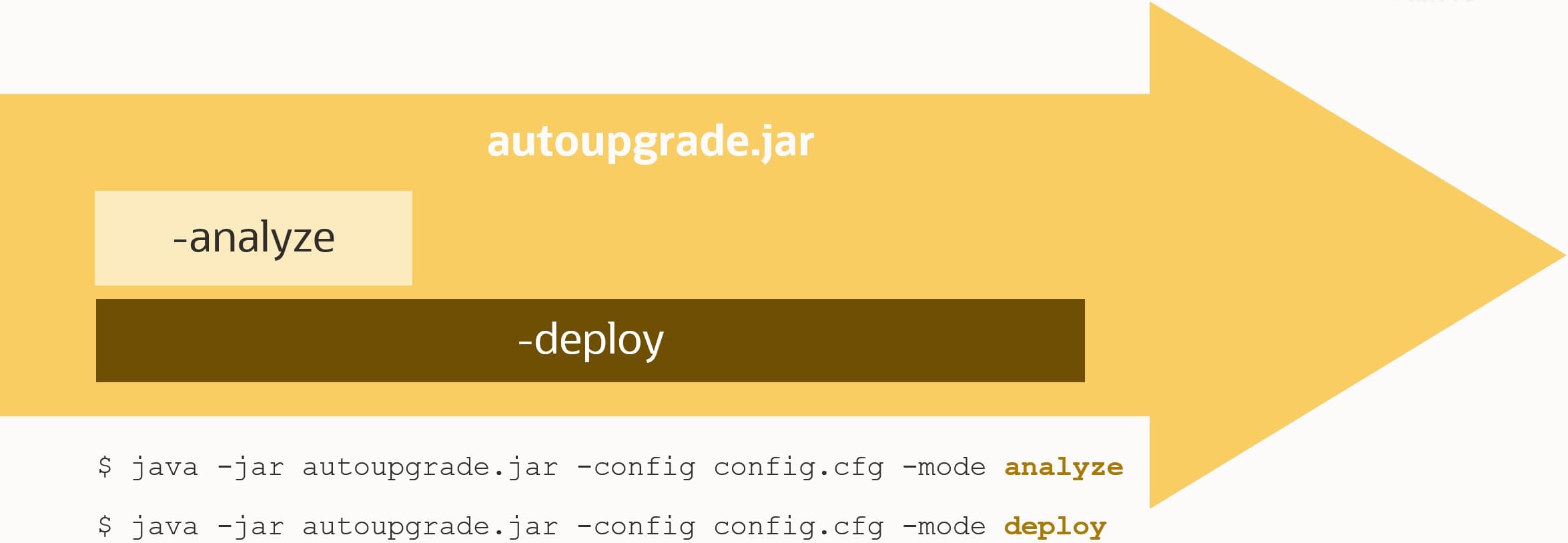
When you upgrade the usual way, i.e., using AutoUpgrade in deploy mode, then you:

  1. Analyze the database – java -jar autoupgrade.jar -mode analyze This is non-intrusive and doesn’t change anything on the database. You get a report, and you can fix any issue that AutoUpgrade can’t fix for you.
  2. Upgrade the database – java -jar autoupgrade.jar -mode deploy The database is analyzed again. Based on the findings of the analysis, a set of preupgrade fixups are executed. Finally, the database upgrade takes place.

Best practice is to use AutoUpgrade in deploy mode

During step #2, the database is not available – you have downtime. Even though the database was analyzed previously, it will be re-analyzed to catch any new issues. This is the safest approach. From the first analysis (in step #1) to the second analysis (in step #2), potentially new issues can occur.

We talked to a few of our customers who are really trying to reduce the downtime of an upgrade. For them – every second counts and has a significant impact on their business. They asked us to make the upgrade faster.

Fast Deploy Mode

One customer suggested moving the final analysis and preupgrade fixup outside of the downtime window. Shortly before the downtime would start, they would like to run an analysis and the preupgrade fixups. Next, they would wait until the downtime window starts and do only the upgrade.

I must stress; there is a risk that a new issue pops up between the fixups and the upgrade – but this one customer is willing to take the risk. In exchange, they will get upgrades with less downtime.

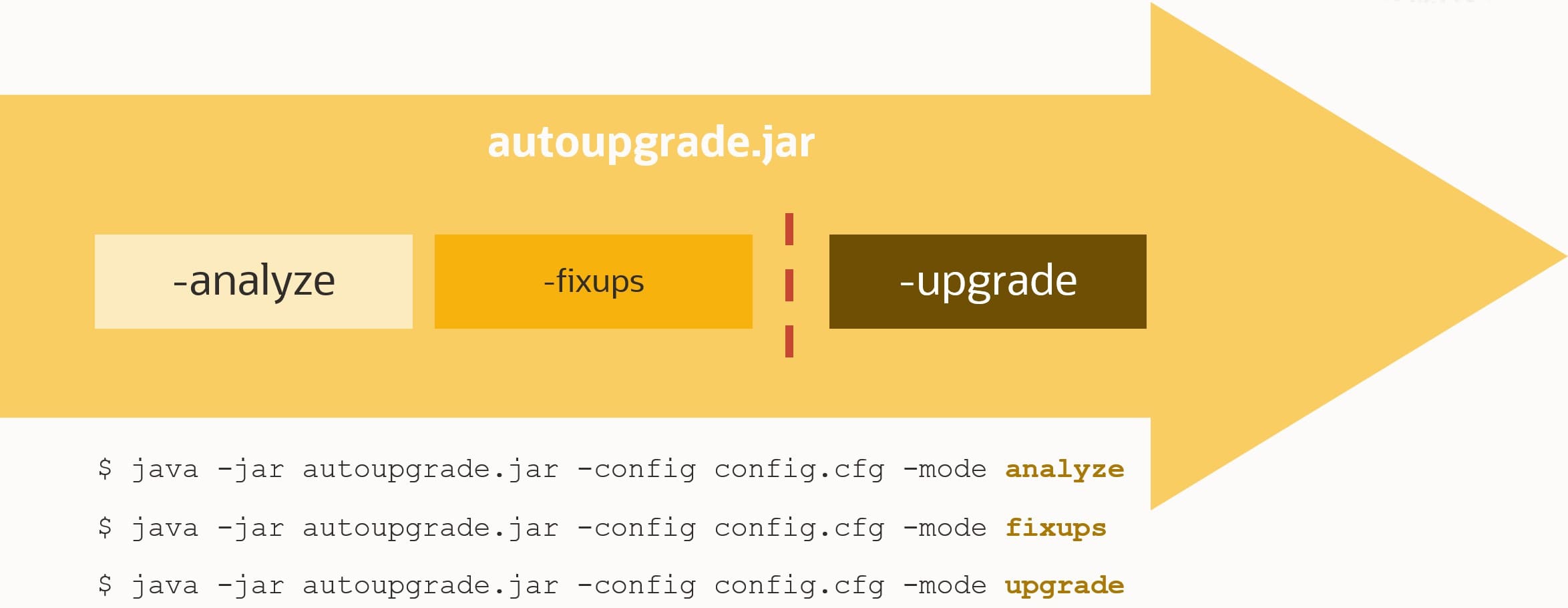
We call this approach fast deploy. The procedure is:

  1. Analyze the database – java -jar autoupgrade.jar -mode analyze
  2. Run the preupgrade fixups – java -jar autoupgrade.jar -mode fixups
  3. Now downtime starts
  4. Upgrade the database – java -jar autoupgrade.jar -mode upgrade

To reduce downtime use the new fast deploy mode - with increased risk

Fast deploy requires AutoUpgrade 21.2 or newer. The target database release can be any of the target releases already supported by AutoUpgrade, meaning 12.2 or higher.

Here are the details of the feature – from the AutoUpgrade change log:

> This feature enables DBA’s to run the prechecks and prefixups while the database is still online and then run deploy to complete the upgrade. Once the fixups have been run on the source database, DBA can then skip the prechecks and prefixup stages and proceed directly to the phases that follow for example: Database can be online: java -jar autoupgrade.jar -mode fixups -config yourconfig Upgrade time: java -jar autoupgrade.jar -mode upgrade -config yourconfig The -mode upgrade command proceeds directly to the phases that follow the prechecks and prefixups stages during deploy. The main goal of this feature is to reduce database downtime by running the fixups when your database is online and open for business and then skipping the fixups when your database is offline. See Oracle documentation for further details.

Conclusion

If your application is really sensitive to downtime, you can now upgrade with less downtime using fast deploy. It introduces a slight risk that the preupgrade analyze will not detect an issue that will cause troubles later on. You have to choose whether that risk is acceptable to you.

Our recommendation is to use the old approach – AutoUpgrade in deploy mode. Consider only fast deploy if downtime really hurts.

If you are interested in seeing which other things got put into AutoUpgrade 21.2, you can check the change log.

Zero Downtime Migration – Logical Migration and Statistics

If you decided to do a logical migration of your Oracle Database with Zero Downtime Migration (ZDM), here is something important about optimizer statistics. You must manually take care of the optimizer statistics on the target database after the Data Pump import. Either by recreating the statistics or transporting the statistics from the source database.

Background

Whenever I talk about migration of Oracle Database with Data Pump, I always mention that it is best practice to exclude optimizer statistics from the Data Pump export. Here is how you do it:

$ expdp ... exclude=statistics

Why is that recommended? Data Pump is not very good at extracting the optimizer statistics. There is nothing wrong with the statistics when they are imported. But it can take a very long time to do the export of statistics.

ZDM and Data Pump

The development team behind ZDM wanted the tool to be easy to use. Also, they wanted ZDM to use all the best practices that come with the various other tools that ZDM uses. When they talked to us about Data Pump, we told them to exclude statistics.

BUT – this also leaves you in a situation where you have a database completely without optimizer statistics. It goes without saying that it is a disaster waiting to happen. You must ensure that optimizer statistics are present on the target database before allowing the users to connect to it.

Regather

One option is to regather optimizer statistics on the target database after the Data Pump import. When the Data Pump import completes, and before you proceed with the switchover, it is time to regather the statistics. Typically, you would start ZDM something like this:

$ zdmcli migrate database .... -pauseafter ZDM_MONITOR_GG_LAG

It will start by performing the initial load of the database with Data Pump. Then it will configure GoldenGate before it pauses – waiting for your signal to complete the migration. At this time, use DBMS_STATS to gather statistics:

SQL> exec dbms_stats.gather_database_stats;

This has some drawbacks:

  • It requires time and resources – which might not be the biggest problem. The source database is still open for business. We haven’t performed the switchover yet.
  • Column usage information (table COL_USAGE$) is not populated, so in some cases, no histograms will be created. This will happen if the database is supposed to automatically determine whether histograms are needed (method_opt includes size auto). In that case, you can merge the column usage information from another database via a database link, which can be a good idea if your application is depending on histograms.
  • The table, schema, or database statistics preferences are not present. It could be degree, method_opt, stale_pct or any other preferences that you can set with DBMS_STATS.SET_TABLE_PREFS (or schema or database-wide preferences). These preferences can be transferred to the new system, which is what I will talk about next.

Transferring Statistics

Another option is to transfer the statistics using DBMS_STATS. We have covered this in detail in a webinar, so I suggest you watch Performance Stability, Tips and Tricks and Underscores for all the details.

In short,

  1. The optimizer statistics in the source database are extracted from the data dictionary and stored in a transportable format in a regular heap table (referred to as a staging table).
  2. Using Data Pump, you move that table to the target database.
  3. Then you put the statistics into the data dictionary of the target database so that optimizer can use them.

Pro tip: You should perform step #1 before you start ZDM and store the staging table in one of the schemas that you are migrating with ZDM. That way, you don’t have to move the table manually. It is moved by ZDM together with the real data.

One thing to be aware of is that the table, schema or database statistics preferences are not transferred when you use e.g. DBMS_STATS.EXPORT_TABLE_STATS. There are dedicated procedures for transferring the statistics preferences:

Conclusion

You must figure out how to move the optimizer statistics into your target database when you use ZDM to perform logical migrations. If not, your target database will be without optimizer statistics which is a disaster waiting to happen.

Appendix

You might now ask. If Data Pump is bad at exporting statistics, but there are already better ways available in the database, why don’t we change the Data Pump code? And you are right – but so far, other things have been prioritized. I would love to see this one day fully embedded in Data Pump.

Other Blog Posts in This Series

Zero Downtime Migration – Logical Online Migration and Testing

How can you test your OCI database before going live? With Logical Online migration it is possible using Flashback Database, restore or cloning. Let’s explore the options.

Flashback Database

Using Flashback Database is the easiest option and it is supported on all target platforms except Autonomous Database (shared and dedicated). In addition, your target database must be Enterprise Edition.

Does Oracle GoldenGate support Flashback Database? You can find the answer in the MOS note Does Goldengate Support Oracle RDBMS Flashback Features? (Doc ID 966212.1):

In a situation where there are only Replicats on a system, then FLASHBACK DATABASE… is fully supported if the Replicats are all using a checkpoint table and the trail files are available that go as far back as the flashback.

When you do Logical Online migrations you only have replicat process in your target database. In addition, checkpoint tables are enabled by default. All good!

Flashback Database – How To

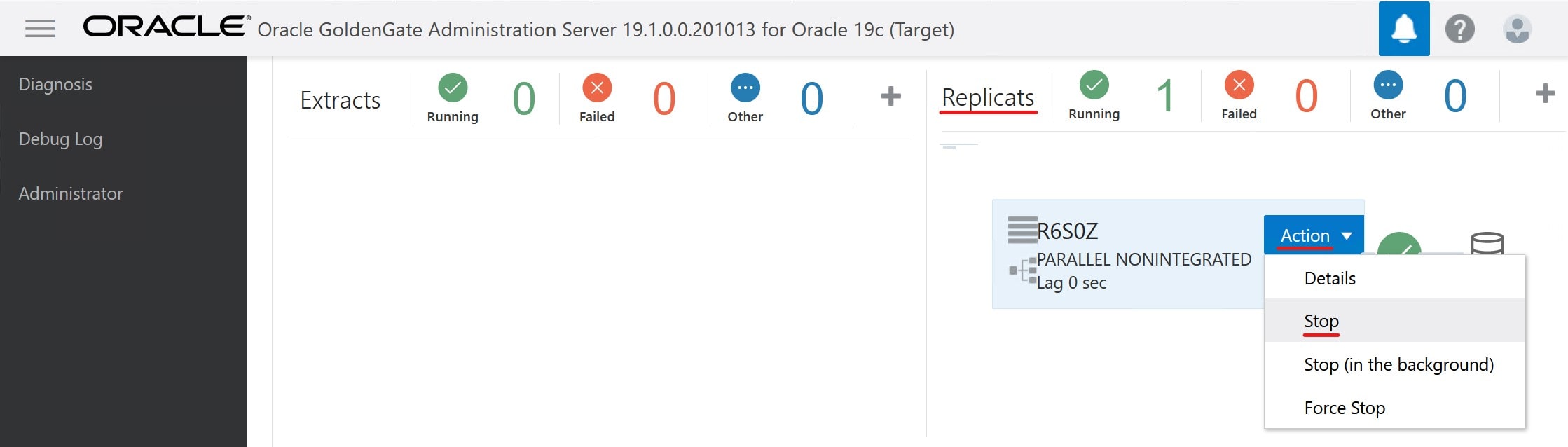
  1. Stop replicat process by logging on to the GoldenGate hub and navigate to the Target Administration Server: How to stop replicat process in Oracle GoldenGate Microservices Architecture Hub
  2. Set a guaranteed restore point in the target PDB (named tgtpdb):
alter session set container=tgtpdb;
create restore point grp4test guarantee flashback database;
  1. Do your tests.
  2. Revert the changes by issuing a FLASHBACK PLUGGABLE DATABASE command:
alter session set container=cdb$root;
alter pluggable database tgtpdb close immediate;
flashback pluggable database tgtpdb to restore point grp4test;
alter pluggable database tgtpdb open resetlogs;
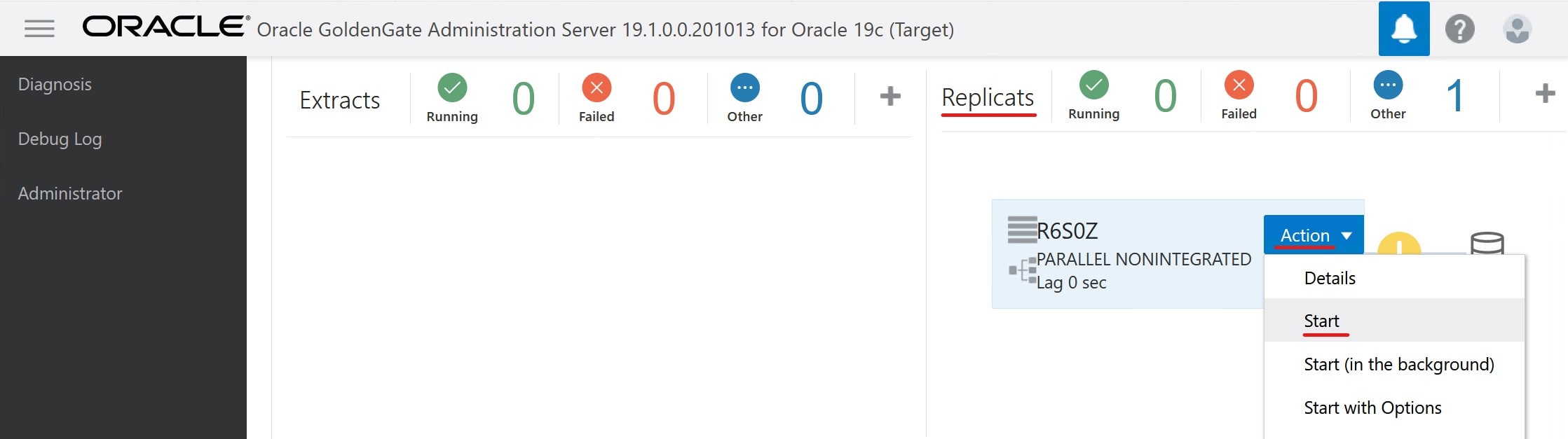
  1. Restart replicat process: How to start replicat process in Oracle GoldenGate Microservices Architecture Hub

The above procedure uses flashback of the pluggable database. This feature was introduced in Oracle Database 12.2. If your target database is 12.1 or older, you have to flashback the entire CDB. If your target database is a non-CDB database, you have to flashback back the entire database.

Restore

Backup/restore is also an option. In OCI it is easy to backup and restore, however, it does take longer than using Flashback Database. But the good thing is that you get to test your OCI backup and recovery strategy.

For Autonomous Database you can use the automatic backups which are enabled by default. In the other Database Cloud Offerings, you must enable automatic backup yourself.

Restore – How To

  1. Stop replicat process (see above)
  2. Create backup (or rely on automatic backup)
  3. Do your tests
  4. Restore backup
  5. Restart replicat process (see above)

Clone

Cloning the database or the entire DB System is also an option. A benefit is that the GoldenGate replication can continue while you are doing the tests. When you use Flashback Database and restore the replication must be stopped. Trail files will accumulate on disk and at one point the target database will be very busy catching up with the lag. For very huge and active systems it might be desirable to work on a clone. However, cloning to a new system mean that you are no longer testing in that specific database that will be your future production database. Also, cloning involves creating new DB Systems which has a cost.

Clone – How To

  1. Clone database or DB System
  2. Do your tests
  3. Discard database or DB System

Conclusion

Before going live in your new OCI database, you should test it. With Logical Online method it is easy, and you can use well-known techniques. If you combine it with the recommendations from our webinar Performance Stability, Tips and Tricks and Underscores, you are well underway towards a successful migration.

Other Blog Posts in This Series

Zero Downtime Migration – Physical Online Migration of Very Large Databases

This blog post is written based on ZDM version 21. The latest version of ZDM has significant changes. Please consult the documentation for updates.

Following the blog post on migrating Very Large Databases (VLDBs) using Logical Online method, let’s touch upon the Physical Online method as well.

Existing Data Guard

VLDBs are very often protected by Data Guard with one or more standby databases. When you start a migration with Zero Downtime Migration (ZDM) you don’t want to promise your existing Data Guard setup. If something happens during the preparation of the migration to OCI, you still want to be able to switch over to an on-prem standby database. Something like this:

Setup with on-prem Oracle Database Data Guard and standby database in OCI

I recommend that you always configure Data Guard using Data Guard broker. ZDM supports using the broker for the migration. If you don’t have Data Guard broker configured, ZDM can use a manual configuration as well.

A few things to observe:

  • When ZDM is working, no switch-overs are allowed. This will cause the process to error out.
  • By working I mean – from the second you start the ZDM migration and until it is paused at ZDM_CONFIGURE_DG_SRC.
  • When ZDM is paused, you can do as many switch-overs as you like. Just ensure that the original source database become the primary database again as soon as possible.
  • When you need to complete the migration, the source database must be the primary database and no switch-overs are allowed. Which does make sense because in this last phase, ZDM is switching over to the OCI target database.
  • What about fail-overs. Fail-overs means loss of data and to accept that you need to open the database with RESETLOGS. This causes all sort of havoc in your Data Guard setup. You are back to start.

At which phases can you switch over to your on-prem standby database without jeopardizing the ZDM migration

The Backup

ZDM needs a full backup that can be restored on your target.

  • DBCS: If your target database is one of the OCI Cloud Services (Virtual Machine, Bare Metal or Exadata DB System), ZDM will need to take a new full backup. Existing backups can’t be used.
  • ExaCC or Exadata on-prem: You can either take a new full backup or use an existing backup that is made available on disk. In addition, if you are so fortunate to have a Zero Data Loss Recovery Appliance (ZDLRA), you don’t need to take a backup. ZDM can just restore directly from ZDLRA.

If you are targeting a DBCS your DATA_TRANSFER_MEDIUM is set to OSS (Object Storage Service). The backup is stored in Object Storage using Oracle Database Cloud Backup Module for OCI. The backup in the source database and the restore in the target database will happen via a special sbt channel which streams the backup directly to and from Object Storage. This means:

  • The backup never hits the disk, so you don’t need additional disk space to hold the backup.
  • The duration of the backup is depending on your network speed to OCI. Since the backup is streamed directly to OCI, the network can become a bottleneck. If you have a slow connection to OCI, the backup will run equally slow. The same applies about the restore, however, the target database is already in OCI and does have a good connection to Object Storage.

ZDM will by default use 10 RMAN channels for the restore and the backup. With your knowledge of the source database, you might know better. You can tweak the number of channels in the response file. Look for the parameters SRC_RMAN_CHANNELS and TGT_RMAN_CHANNELS.

Based on your knowledge or testing you can determine which RMAN Compression algorithm that gives the best benefit on your database. You can adjust the compression algorithm in the response file using the parameter ZDM_RMAN_COMPRESSION_ALGORITHM. The default is MEDIUM which is normally gives the best balance between compression ratio and CPU time. And remember, RMAN Compression normally require a license for Advanced Compression Option but when you migrate with ZDM, there is a restricted use license.

While ZDM is taking a backup of the source database, no other backups should be running. Be sure to put your regular backups, including archive backups, on hold.

Redo Apply

In the source database, you should keep archive logs on disk until the target database has been restored, Data Guard has been configured, and the target database has caught up with redo apply. If you have a slow network connection and a huge database, it can take days until the backup has completed, restored has completed and redo apply has caught up.

  • Imagine you start the backup at sequence 100.
  • The restore of the target database finishes two days later. The source database is now at sequence 200.
  • ZDM configure Data Guard and starts redo transfer and redo apply. The source database is now at sequence 220.
  • Sequences 100-220 must be available on disk on the source database host, so the source (primary) database can transfer them to the target (standby) database.

It is not uncommon for VLDBs to generate redo on a daily basis that are double-digit TB. Just the other day I talked to a customer whose database generated 15 TB of archive logs a day.

First, you must be able to transfer the redo from the source database (primary) to the target database (standby). This is simple math: If you have 15 TB redo a day, you should be able to transfer that using a 1,5 Gbps connection (amount of redo / 24 / 60 / 60 * 8). If transferring redo becomes a problem, you can look into using redo transport compression. This can reduce the amount of data that must be transferred at the cost of CPU cycles. You can read more about it in the MOS note Redo Transport Compression in a Data Guard Environment (Doc ID 729551.1). I learned from colleagues in the Maximum Availability Architecture (MAA) team that TDE Tablespace Encryption and redo transport compression doesn’t play very well together. If your source database is encrypted, you should not expect that much benefit from redo transport compression.

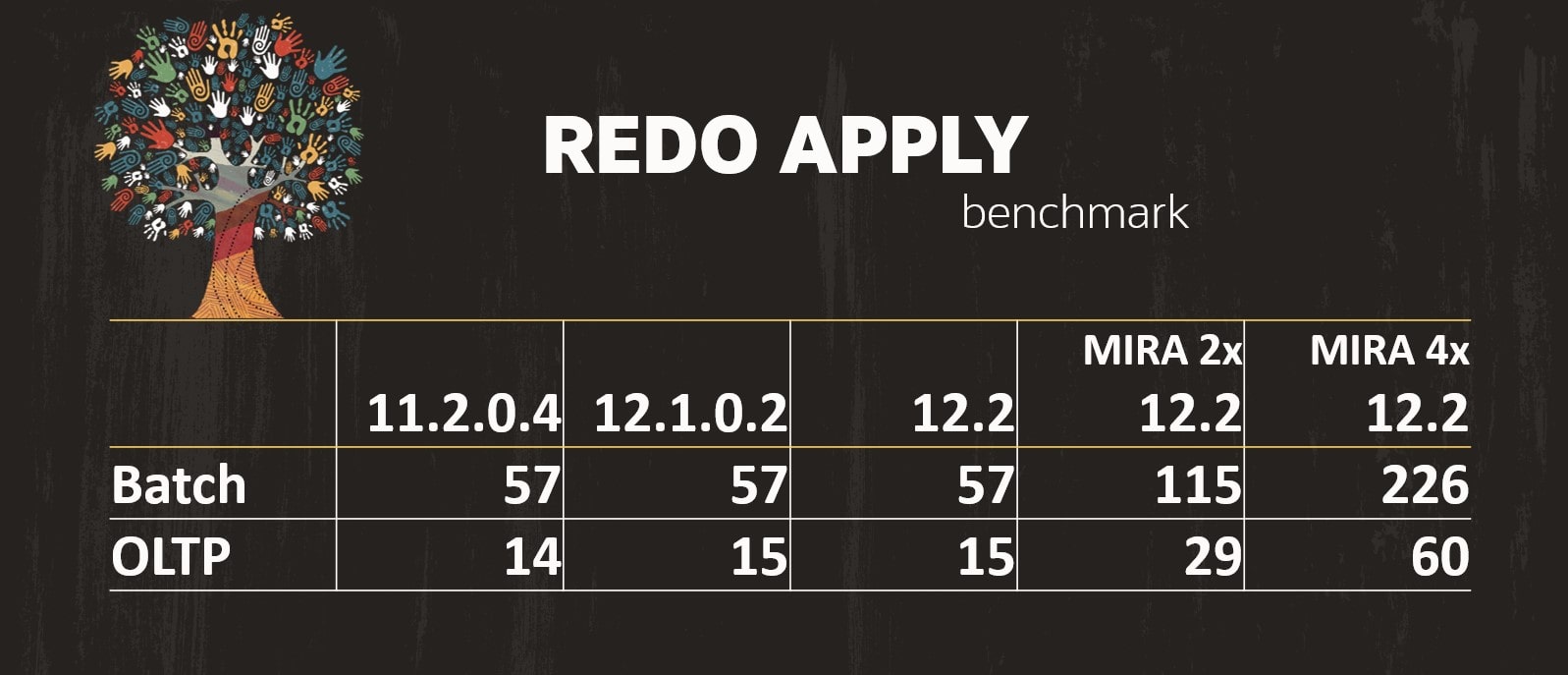
Next, redo must be applied on the target database. Is the target database capable of applying redo so fast? On Exadata the answer is most likely: YES – but as always in IT, it depends. Redo Apply benchmark of Oracle Database Data Guard The numbers of the above graph comes from Redo Apply Best Practices – Oracle Data Guard and Active Data Guard. Based on your database release and the type of workload you have in the database; you can see the amount of redo that can be applied daily (in TB). The last two columns are using Multi-Instance Redo Apply (MIRA) with either two or four active RAC nodes. The numbers were generated on an Exadata.

Backup of Target Database

How do you backup your target database in OCI? You want to have a valid backup from the very second that you switch over to the target database.

The target placeholder database that you originally created will be overwritten by ZDM. This means that you can’t configure and enable automatic backup in OCI in advance. You must wait until the migration has completed until you enable automatic backup.

You could:

  • Extend the downtime window to allow automatic backup to be configured after the migration. Also, allow enough time for the first backup to complete.
  • Or, do your own backup in OCI. This is more cumbersome but will allow you to open the database for business immediately after the switchover. But you are in charge of the backup now. All the various bits and pieces are available:
    • Original backup is still in object storage.
    • Archive logs are on disk – you can back them up manually.
    • Perform incrementals if needed – put them somewhere safe.
    • In case of emergency – glue it all together

Data Guard on Target Database

Similar to automatic backup, you can’t create a Data Guard Association until ZDM has completed the migration. The cloud tooling does not support creating the standby database through a cascading standby. This means that you can’t build your OCI standby database until after ZDM has completed the migration – and the OCI database is the primary database. You can start to create the OCI Data Guard as soon as ZDM is done, but

  • You must tolerate that the OCI Data Guard is missing
  • Or, take downtime

Conclusion

Even huge Oracle Databases can be migrated to OCI using Zero Downtime Migration. You might need to make a few adjustments from the standard flow, but it is absolutely doable. Automatic backup and data guard can’t be created in OCI until after the migration. This might force you to take downtime. Besides the actual migration, you should also do your best to ensure performance stability once the database is open for business. For that purpose, you should have a look at our webinar Performance Stability, Tips and Tricks and Underscores.

Other Blog Posts in This Series

Zero Downtime Migration – Logical Online Migration of Very Large Databases

Things always work on PowerPoint slides. And they almost always work in our lab environments as well. And recorded demos are also pretty bullet-proof.

But what happens when you have a huge database to migrate? A Very Large Database (VLDB). First, things get more exciting. Second, there are more knobs to turn and the smallest thing might become a big thing. Here are some things to consider when you migrate VLDBs using the Logical Online method.

Existing Data Guard No need to worry about your existing on-prem Oracle Data Guard environment. The Logical Migration uses Oracle Data Pump and Oracle GoldenGate. Both tools can be used on a database in a Data Guard and does not interfere with Data Guard operations.

But no switchovers or failovers are allowed during replication. GoldenGate can be configured to fully support a Data Guard environment and seamlessly reconnect in case of a Data Guard switchover. But it requires advanced configuration of GoldenGate. Zero Downtime Migration (ZDM) does the GoldenGate configuration but does so in a basic way that does not support Data Guard switchovers.

Data Pump Data Pump is used for the initial load of data.

The initial load happens before downtime, so generally you shouldn’t worry too much about the time it takes to perform the Data Pump export and import. However, the longer it takes, the bigger a replication will GoldenGate need to catch up. If the gap is too big, it might become a problem.

Apply a proper degree of parallelism. Rule-of-thumb:

On-prem: 2 x number of physical cores OCI: Number of OCPUs You can change the Data Pump parallel setting using the ZDM response file parameters DATAPUMPSETTINGS_DATAPUMPPARAMETERS_EXPORTPARALLELISMDEGREE and DATAPUMPSETTINGS_DATAPUMPPARAMETERS_IMPORTPARALLELISMDEGREE

When you are importing in OCI, consider scaling up on CPUs. More CPUs, more Data Pump parallel, faster import. Bare Metal and Exadata DB Systems scales online, whereas Virtual Machines needs around 10 minutes of downtime.

ZDM applies Data Pump compression automatically. Remember you don’t need a license for Advanced Compression Option to use compression when you are migrating with ZDM. Our experience is that MEDIUM most of the time is the best alternative. It provides a good compression ratio at a low CPU footprint. Although HIGH can compress better, it often comes at a much higher CPU footprint. ZDM uses MEDIUM compression algorithm. It’s not possible to change the Data Pump compression algorithm. The interested reader may find a benchmark below, that compares the different compression algorithms:

ZDM automatically transforms BasicFile LOBs into SecureFile LOBs – which is very good. SecureFile LOBs are superior in many ways, also when it comes to importing. Based on a customer case, we did a benchmark that measures the time it takes to import LOB data. The customer saw a 3x improvement during by transforming to SecureFile LOBs – and got the benefits of SecureFile LOBs afterwards. ZDM transforms to SecureFile LOBs automatically. Don’t turn it off. Here are the log entries from the two imports. Notice the elapsed time:

BasicFile LOBs

10-OCT-20 21:43:21.848: W-3 . . imported "SCHEMA"."TABLE" 31.83 GB 681025 rows in 804 seconds using direct_path

SecureFile LOBs

15-OCT-20 18:16:48.663: W-13 . . imported "SCHEMA"."TABLES" 31.83 GB 681025 rows in 261 seconds using external_table Don’t use import over network link. Use dump files. Performance-wise there are some restrictions when you import over network link. These restrictions really hurt on a VLDB.

The Data Pump works will automatically be started on all nodes, if the target database is a RAC database. That should allow for the fastest possible import. If needed, you can force all workers on to the same node using DATAPUMPSETTINGS_DATAPUMPPARAMETERS_NOCLUSTER

But when you export to dump files, remember to ensure you have adequate disk space on the source database host to hold the dump file. Use mount points that can deliver good write performance and ideally, they should be separated from the storage that holds the database data files.

A Data Pump export does not affect your existing backup operations. But the export and the backup will fight over the same resources, so I recommend suspending major backup operations (level 0+1) until after the export.

Speaking of fighting over resources. You should run the export at off peak hours. That will allow the export to use many more resources. The export is not a fully consistent export. Each table is consistent, but ZDM does not use FLASHBACK_TIME or FLASHBACK_SCN to make the entire export consistent. This helps avoid ORA-01555 snapshot too old during the export. The SCN of each table is recorded in the dump file and GoldenGate later on uses that information to start replication on each table individually from the appropriate SCN.

GoldenGate Replication How much data will GoldenGate need to transfer from source database to GoldenGate hub and from GoldenGate hub to target database? GoldenGate stores the replication data in trail files. The trail files are smaller than redo logs. The size of trail files is typically 30-40 % of the size of the redo logs. Imagine a database generating 15 TB of redo a day. The size of the trail files will be 4,5-6 TB. If you further apply compression on the trail files, you can typically reduce the size to around 1/8. Using our example, the trail files are now 550-750 GB. Which is significantly less than the initial 15 TB.

In the ZDM response file there is a parameter called GOLDENGATESETTINGS_EXTRACT_PERFORMANCEPROFILE. The default value is MEDIUM, but you have the option of changing it do HIGH. This should increase the performance of the extract process.

ZDM configure GoldenGate to use Parallel Replicat. This gives you a few options. First, you can control the number of mappers by using the parameter GOLDENGATESETTINGS_REPLICAT_MAPPARALLELISM (default is 4). Also, apply parallelism is auto-tuned. You can set a minimum and maximum value using GOLDENGATESETTINGS_REPLICAT_MINAPPLYPARALLELISM and GOLDENGATESETTINGS_REPLICAT_MAXAPPLYPARALLELISM=50. Defaults are 4 and 50 so I don’t think it will be necessary to change.

By default, ZDM does not configure GoldenGate with DDL replication. Replicating without DDL gives the best performance. If you must have DDL replication in your migration project, you can look at the ZDM response file parameter GOLDENGATESETTINGS_REPLICATEDDL. But be prepared for a performance degradation.

In our webinar, Migrating Very Large Databases my team and I discuss what to consider when migrating databases with GoldenGate.

Last, you can find more advice in Administering Oracle GoldenGate 19.1, Tuning the Performance of Oracle GoldenGate.

GoldenGate Health Check Oracle GoldenGate comes with health check scripts that you can use on the source and target database. This will help you monitor and troubleshoot the process. Here is information on how to install and use the health check scripts. You can also find information in Administering Oracle GoldenGate 19.1, Using Healthcheck Scripts to Monitor and Troubleshoot.

Backup of Target Database When you use logical online migration in ZDM, you create the target database in advance. In contrast to physical migration, the target database is not overwritten. This means that you can configure automatic backup of your target OCI database before you complete the migration and switch over to OCI. You will even have time to and possibility of testing the backup.

I recommend that you configure automatic backup after the Data Pump initial load. This way there is less archive logs to back up as well.

Data Guard on Target Database Similar to automatic backup, you can also create your Data Guard association before the switchover. Likewise, wait until after the initial load has completed.

Conclusion Even huge Oracle Databases can be migrated to OCI using Zero Downtime Migration. You might need to make a few adjustments from the standard flow, but it is absolutely doable. Your database can be protected by backup and Data Guard from the very second you switch over to OCI. Besides the actual migration, you should also do your best to ensure performance stability once the database is open for business. For that purpose, you should have a look at our webinar Performance Stability, Tips and Tricks and Underscores.

Other Blog Posts in This Series Introduction Install And Configure ZDM Physical Online Migration Physical Online Migration to DBCS Physical Online Migration to ExaCS Physical Online Migration and Testing Physical Online Migration of Very Large Databases Logical Online Migration Logical Online Migration to DBCS Logical Offline Migration to Autonomous Database Logical Online Migration and Testing Logical Online Migration of Very Large Databases Logical Online and Sequences Logical Offline Migration How To Minimize Downtime Logical Migration and Statistics Logical Migration and the Final Touches Create GoldenGate Hub Monitor GoldenGate Replication The Pro Tips

Zero Downtime Migration – Physical Online Migration and Testing

Testing is an essential part of any migration project of your Oracle Database. With Zero Downtime Migration (ZDM) and the Physical Online method it has become a lot easier. Before going live (i.e. doing the Data Guard switchover) you can test on your production data on your future production system – the OCI database. That’s cool.

Concept

For the duration of your test convert the OCI target database into a snapshot standby database. A short recap on snapshot standby database:

  • A snapshot standby database is a type of updatable standby database that provides full data protection for a primary database.
  • A snapshot standby database receives and archives, but does not apply, redo data from its primary database. Redo data received from the primary database is applied when a snapshot standby database is converted back into a physical standby database, after discarding all local updates to the snapshot standby database.
  • A snapshot standby database diverges from its primary database over time because redo data from the primary database is not applied as it is received. Local updates to the snapshot standby database cause additional divergence. The data in the primary database is fully protected however, because a snapshot standby can be converted back into a physical standby database at any time, and the redo data received from the primary is then applied.

The plan is:

  1. Build the standby database in OCI.
  2. Migration is currently paused at ZDM_CONFIGURE_DG_SRC (-pauseafter ZDM_CONFIGURE_DG_SRC).
  3. Convert the OCI target database – which is a physical standby – into a snapshot standby.
  4. Do your test. Do whatever you want. The database is protected by Flashback Database, so you can insert and delete data, truncate, add tablespaces, you name it.
  5. When you are done with your tests, convert the OCI target database back into a physical standby database. Implicitly, the database is flashed back, and now the redo is getting applied again.
  6. After a little while the target database is now back in sync again.
  7. Complete migration at your will.

How

You find the steps needed to conver to snapshot standby and back again below. You can repeat the process as many times as you want.

Manual

To convert the standby database to snapshot standby:

alter database recover managed standby database cancel;
shutdown immediate
startup mount
alter database convert to snapshot standby;
alter database open;

Now, the database is opened in READ WRITE mode and you can use it for testing. To convert back to a physical standby database:

shutdown immediate
startup mount
alter database convert to physical standby;
shutdown immediate
startup
alter database recover managed standby database disconnect from session;

Manual on RAC

To convert the standby database to snapshot standby:

sqlplus / as sysdba <<EOF
   alter database recover managed standby database cancel;
EOF
srvctl stop database -d $ORACLE_UNQNAME
srvctl start database -d $ORACLE_UNQNAME -o mount
sqlplus / as sysdba <<EOF
   alter database convert to snapshot standby;
   alter database open;
EOF

Now, the database is opened in READ WRITE mode and you can use it for testing. The database is only opened on one node. You can open the other nodes by executing the following on each of the nodes:

alter database open;

To convert back to a physical standby database:

srvctl stop database -d $ORACLE_UNQNAME
sqlplus / as sysdba <<EOF
   startup mount
   alter database convert to physical standby;
   shutdown immediate
EOF
srvctl start database -d $ORACLE_UNQNAME
sqlplus / as sysdba <<EOF
   alter database recover managed standby database disconnect from session;
EOF

Data Guard Broker

To convert the standby database to a snapshot standby database using broker (CDB19_fra3zt is the target DB_UNIQUE_NAME):

convert database 'CDB19_fra3zt' to snapshot standby;

Now, the database is opened in READ WRITE mode and you can use it for testing. To convert back to a physical standby database:

convert database 'CDB19_fra3zt' to physical standby;

Conclusion

One of the really cool features of ZDM is that you can use my standby database for testing in OCI – before I decide to do the switchover. You can achieve this by converting to a snapshot standby database.

Finally, a thank you to my colleague Jose Bennani Pareja for helping out with RAC database information.

Other Blog Posts in This Series

Zero Downtime Migration – Physical Online Migration to ExaCS

This will be an easy blog post. To migrate your Oracle Database to Exadata DB System (ExaCS), just follow this procedure from the DBCS blog post. Plus, execute these two commands on the target after the migration:

[root@tgthost]$ dbaascli registerdb prereqs --dbname [db_name] --db_unique_name [db_unique_name]
[root@tgthost]$ dbaascli registerdb begin --dbname [db_name] --db_unique_name [db_unique_name]

More Details, Please

Granted – the above statement is bold and it is almost true. There are a few important details to share. First, have a look at Additional Information for Migrating to Exadata Cloud Service which you find the Release Notes

Target Environment

To get the full benefits of Exadata you should be running RAC databases. Exadata and RAC is a perfect match but it is up to you to decide. If your source database is already a RAC database (or RAC One Node) you must migrate to a RAC database. However, if your source database is a single instance you have to option to either stay single instance or go RAC. If you go RAC, just create the target placeholder database as a RAC database, and everything else will happen automatically.

You must create a placeholder database on the target system. The placeholder database gets overwritten ZDM during the migration but it is initially used by ZDM to get information on how you want to configure your target database in OCI. For example, the migrated database will be placed in the same Oracle Home as the target placeholder database. Also, the architecture is determined this way. In other words, if you create the target placeholder database as a RAC database; then your source database is automatically converted to a RAC database during migration. If you create a single instance placeholder database; you get a single instance database.

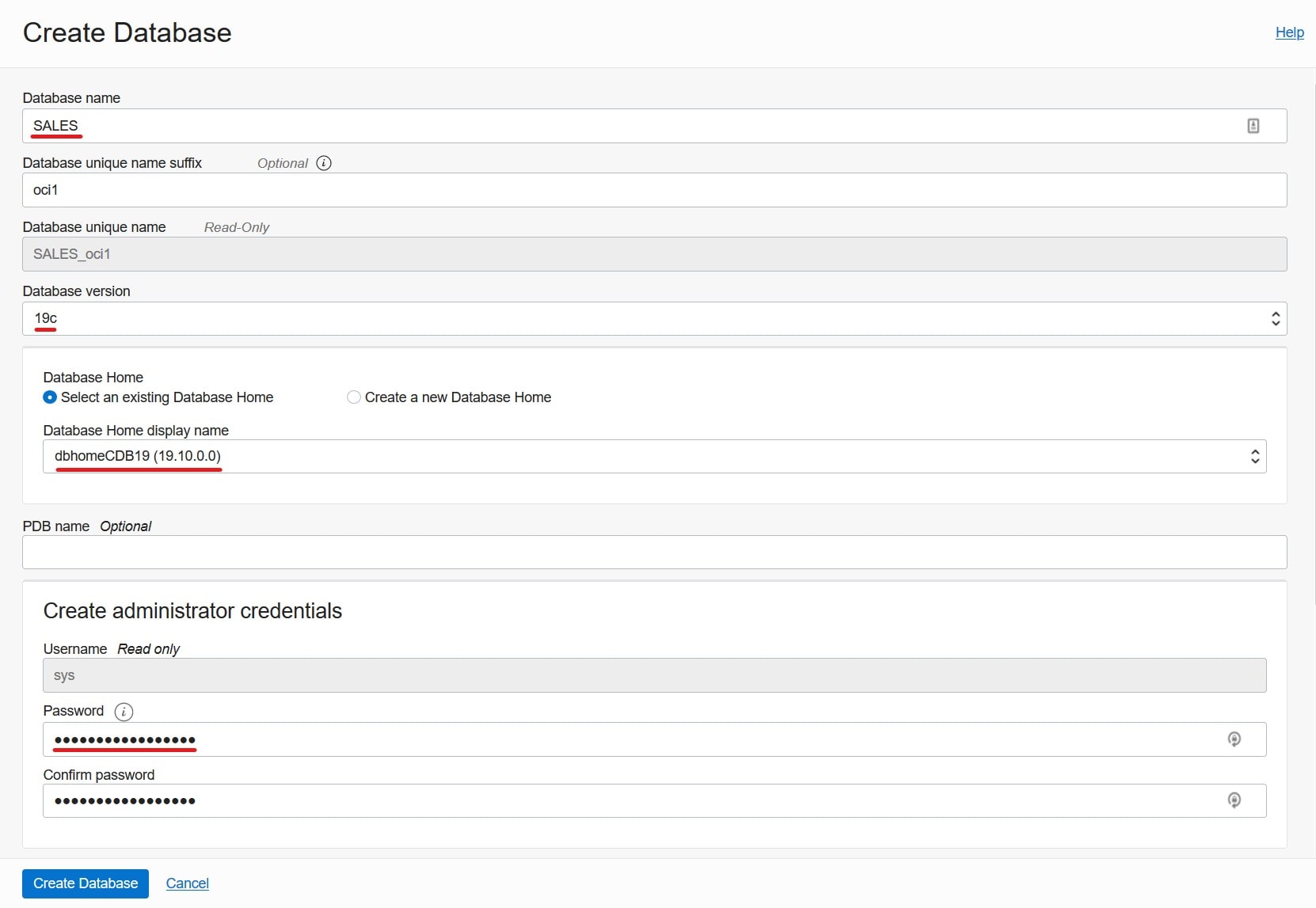
Just like any other migration, when creating the placeholder database there are some things you should be aware of. On the OCI webpage you have to:

  • Set Database name to the DB_NAME of the source database.
  • Set Database version to the same as the source database.
  • Ensure the patch level of the Oracle Home match that of the source system – or be higher.
  • Ensure that the Password matches the SYS password of the source database.

When using Zero Downtime Migration (ZDM) to migrate to Exadata DB System (ExaCS) be sure to create the target placeholder database in the correct manner.

You can choose your own DB_UNIQUE_NAME – it should differ from the source database. Select an Oracle Home that has the same or higher patch level than your source database. I recommend to always migrate to the latest Release Update. If necessary, ZDM will automatically invoke datapatch after the switchover. The other parameters don’t matter – the database gets overwritten anyway by ZDM. Also, be aware when using the OCI webpage you get a RAC database. There is no option to change it. But it is after all the perfect match for Exadata anyway.

Now, if you want more advanced options – like creating a single instance database, you can’t use the OCI webpage. You will have to use either dbaaspi or dbaascli. That gives you full control over the options – but they are not as easy to use as the webpage.

It’s A Wrap

I have created a video on YouTube that demos a migration to Exadata DB System.

Speaking of YouTube, I suggest that you subscribe to the Oracle Database Upgrades and Migrations YouTube channel so you never miss anything.

The Exadata Cloud Service is an awesome platform and it is really easy to migrate to it using Zero Downtime Migration. And converting to RAC is even easier.

Other Blog Posts in This Series

Zero Downtime Migration – Physical Online Migration to DBCS

Let me show you how you can migrate an Oracle Database into OCI. My source database is a CDB running on 12.1.0.2. I want to migrate to the same version using the Physical Online method which uses Data Guard.

This procedure can be used to migrate to:

  • VM DB Systems
  • Bare Metal DB Systems
  • Exadata DB System (ExaCS)

If you want to migrate to Exadata Cloud at Customer and Exadata on-prem, you can use a lot from this post, but there are some differences which I will not cover.

Prerequisites

  1. I need a ZDM service host. It is called zdmhost and the user is called zdmuser.
  2. My source database is a CDB called SALES (DB_NAME), and the host is named srchost.
  3. I want to migrate to a VM DB System, and it is already created. I name it tgthost. I use the same name for the database, SALES. I must use ASM as storage management software.
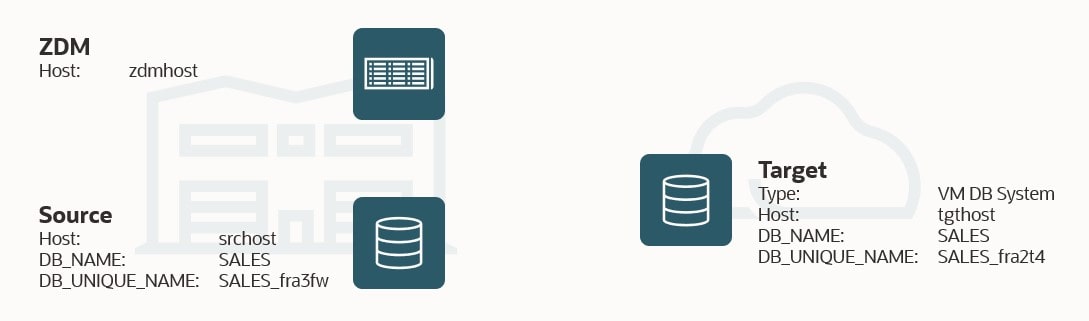
Overview of the components in this demo

Prepare Source

Ensure the database is in ARCHIVELOG mode:

select log_mode from v$database;

If database version is 12.2 or higher, a TDE keystore must be present – even if the database is not encrypted. A license is not needed to create a TDE keystore – not until data is getting encrypted. The keystore must be OPEN and the type is either AUTOLOGIN, LOCAL_AUTOLOGIN or PASSWORD. In a CDB, this applies to CDB$ROOT and all PDBs:

SELECT con_id, status, wallet_type FROM v$encryption_wallet;

If status is OPEN_NO_MASTER_KEY it means that no TDE master encryption key has been created and I will need to create one. Instructions are also in the documentation.

Ensure that the source host can resolve the network name of the target host. It is important to add two entries – one with the host name and one with the SCAN name (they should both point to the target host):

[root@srchost]$ echo -e "[ip address] tgthost" >> /etc/hosts
[root@srchost]$ echo -e "[ip address] tgthost-scan" >> /etc/hosts

Test connection over SQL*NET to the target:

[oracle@srchost]$ sqlplus system@tgthost-scan/[target-cdb-service-name]

Prepare Target

I need a target placeholder database. The placeholder target database is overwritten during migration, but it retains the overall configuration.

  • VM DB System: When I create a new system, a database is automatically created. This database is my target placeholder database.
  • Bare Metal and Exadata DB Systems: Create a new database on an existing system.

In any case:

  • DB_NAME must exactly match that of the source database – also in the same case.
  • DB_UNIQUE_NAME must be different.
  • Use the same SYS password as the source database.
  • Any database parameters for the target database, including SGA parameters, are maintained during the migration, and the migrated database runs with this same configuration.
  • Do not enable automatic backup (until after the migration has completed).
  • The architecture (single instance or RAC) of the target placeholder database determine the architecture of the OCI database. If I want my OCI database to be a RAC database, simply create the target placeholder database as a RAC database, and the end result will be a RAC database.
  • COMPATIBLE must match that of the source database.
  • The patch level of the target database must be equal to or higher than the source database. If they differ, ZDM will automatically execute datapatch as part of the migration. Use $ORACLE_HOME/OPatch/opatch lsinventory.
  • The source and target database must use the same time zone file version. If they don’t match, I must upgrade the time zone file in the source database. If I have a lot of data of type TIMESTAMP WITH TIMEZONE and I can’t afford the downtime it takes to do the upgrade, then consider using the logical online method: select * from v$timezone_file;

There are a few other requirements listed in the document, but these are the most important ones.

Like the source host, the target host must be able to resolve the network name of its counterpart:

[root@tgthost]$ echo -e "[ip address] srchost" >> /etc/hosts
[root@tgthost]$ echo -e "[ip address] srchost-scan" >> /etc/hosts

And I test the connection:

[oracle@tgthost]$ sqlplus system@srchost-scan/[source-cdb-service-name]

Prepare ZDM

The ZDM service host must be able to resolve the host names of the source and target database host:

[root@zdmhost]$ echo "<source IP address> srchost" >> /etc/hosts
[root@zdmhost]$ echo "<target IP address> tgthost" >> /etc/hosts

I put my private SSH keys to the source and target database host into ~/.ssh directory. Ensure permissions are set properly:

[zdmuser@zdmhost]$ cp srchost_key_file ~/.ssh
[zdmuser@zdmhost]$ chmod 400 ~/.ssh/srchost_key_file 
[zdmuser@zdmhost]$ cp tgthost_key_file ~/.ssh
[zdmuser@zdmhost]$ chmod 400 ~/.ssh/tgthost_key_file 

Test the connection. I connect as opc, but you might have a different user. Read more about access to the database host in the documentation:

[zdmuser@zdmhost]$ ssh -i ~/.ssh/srchost_key_file opc@srchost date
[zdmuser@zdmhost]$ ssh -i ~/.ssh/tgthost_key_file opc@tgthost date

Prepare Response File

I will use a template response file as the basis for my response file:

[zdmuser@zdmhost]$ cp $ZDM_HOME/rhp/zdm/template/zdm_template.rsp ~/physical_online.rsp
[zdmuser@zdmhost]$ chmod 700 ~/physical_online.rsp

This is the response file that I end up with (see appendix B for an explanation):

TGT_DB_UNIQUE_NAME=SALES_fra2t4
MIGRATION_METHOD=ONLINE_PHYSICAL
DATA_TRANSFER_MEDIUM=OSS
PLATFORM_TYPE=VMDB
HOST=https://swiftobjectstorage.[region].oraclecloud.com/v1/[my-tenancy-object-storage-namespace]
OPC_CONTAINER=zdm-staging
SKIP_FALLBACK=TRUE
SHUTDOWN_SRC=TRUE

If your database is Oracle Database 11.2.0.4 be sure to set these response file parameters:

ZDM_RMAN_DIRECT_METHOD=ACTIVE_DUPLICATE
ZDM_USE_DG_BROKER=FALSE

Perform Evaluation

I am now ready to perform a migration evaluation. It is a dry run of the migration and performs various sanity checks. Nothing is changed during the evaluation:

[zdmuser@zdmhost]$ $ZDM_HOME/bin/zdmcli migrate database \
   -rsp /home/zdmuser/physical_online.rsp \
   -sourcenode srchost \
   -sourcedb SALES_fra3fw \
   -srcauth zdmauth \
   -srcarg1 user:opc \
   -srcarg2 identity_file:/home/zdmuser/.ssh/srchost_key_file \
   -srcarg3 sudo_location:/usr/bin/sudo \
   -targetnode tgthost \
   -tgtauth zdmauth \
   -tgtarg1 user:opc \
   -tgtarg2 identity_file:/home/zdmuser/.ssh/tgthost_key_file \
   -tgtarg3 sudo_location:/usr/bin/sudo \
   -targethome /u01/app/oracle/product/12.1.0.2/dbhome_1 \
   -backupuser "daniel.overby.hansen@oracle.com" \
   -eval

A few comments:

  • sourcenode and targetnode are the host names of the source and target database host. Those names must be resolvable which I why I put them into /etc/hosts already.
  • sourcedb is the DB_UNIQUE_NAME of the source database. My database is on ASM. If I didn’t use ASM I should use sourcesid instead and specify the database SID.
  • srcarg1 is the name of the user that I connect as to the source database host. You might need to change that.
  • srcarg2 and tgtarg2 is the location of the private key files to the source and target database host respectively. The private key file must be usable by the user that is specified in srcarg1 and tgtarg1 which in this case is opc.

I am prompted for the SYS password to the source database and also the password for the backupuser (which is my OCI user). For the latter, please note that this password is not my user password, however, it is an auth token. I also get a job ID: When using OCI oject storage this is NOT your user password, but an auth token

The migration evaluation is then started, and I can use the job ID to monitor it:

[zdmuser@zdmhost]$ $ZDM_HOME/bin/zdmcli query job -jobid <job ID>
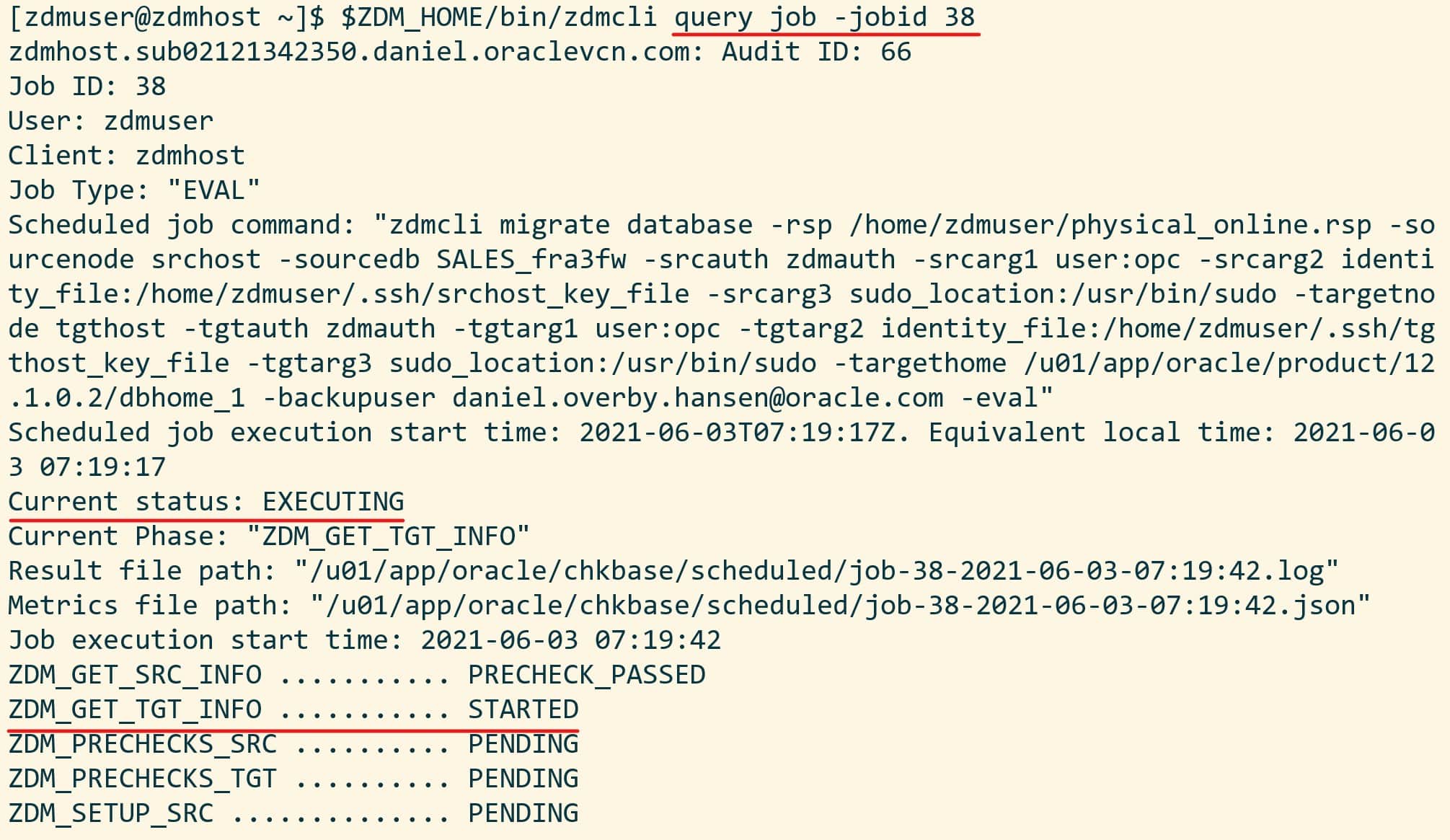
Output from zdmcli query job command

My colleague Sinan Petrus Toma showed how to loop:

[zdmuser@zdmhost]$ while :; do $ZDM_HOME/bin/zdmcli query job -jobid <job ID>; sleep 10; done

However, I prefer to get more details, so I tail the ZDM log file instead. This little one-liner finds the newest file and tails it:

[zdmuser@zdmhost]$ tail -n 50 -f "`ls -td /u01/app/oracle/chkbase/scheduled/*log | head -1`"

And I get this level of detail:

zdmhost: 2021-06-03T07:19:50.317Z : Starting zero downtime migrate operation ...
zdmhost: 2021-06-03T07:19:53.445Z : Executing phase ZDM_GET_SRC_INFO
zdmhost: 2021-06-03T07:19:53.446Z : Retrieving information from source node "srchost" ...
zdmhost: 2021-06-03T07:19:53.447Z : retrieving information about database "SALES_fra3fw" ...
zdmhost: 2021-06-03T07:20:02.743Z : Execution of phase ZDM_GET_SRC_INFO completed
zdmhost: 2021-06-03T07:20:02.826Z : Executing phase ZDM_GET_TGT_INFO
zdmhost: 2021-06-03T07:20:02.827Z : Retrieving information from target node "tgthost" ...
zdmhost: 2021-06-03T07:20:12.197Z : Determined value for parameter TGT_DATADG is '+DATA'
zdmhost: 2021-06-03T07:20:12.198Z : Determined value for parameter TGT_REDODG is '+RECO'
zdmhost: 2021-06-03T07:20:12.198Z : Determined value for parameter TGT_RECODG is '+RECO'
zdmhost: 2021-06-03T07:20:12.203Z : Execution of phase ZDM_GET_TGT_INFO completed

Eventually, I end up with a successful evaluation: When status of an evaluation is SUCCEEDED
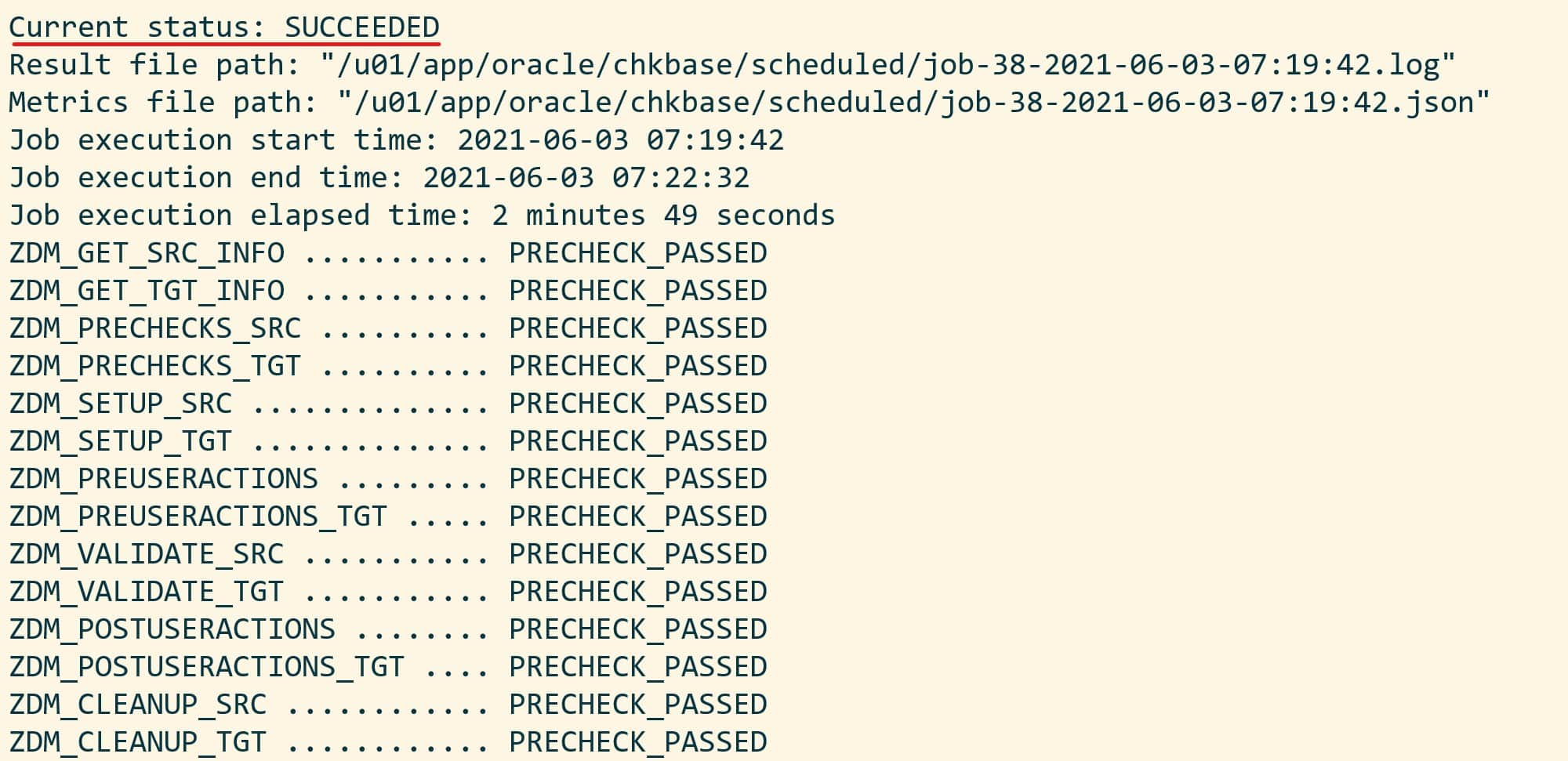
Start Migration

When the evaluation passes, I can start the real migration. I am re-using the same command line, but I have removed the -eval option. Instead – and this is important – I am using -pauseafter to tell ZDM to pause the migration, just before the switchover takes place. Downtime has not started yet. The database is still open for business, but ZDM will copy the data and configure Data Guard:

[zdmuser@zdmhost]$ $ZDM_HOME/bin/zdmcli migrate database \
   -rsp /home/zdmuser/physical_online.rsp \
   -sourcenode srchost \
   -sourcedb SALES_fra3fw \
   -srcauth zdmauth \
   -srcarg1 user:opc \
   -srcarg2 identity_file:/home/zdmuser/.ssh/srchost_key_file \
   -srcarg3 sudo_location:/usr/bin/sudo \
   -targetnode tgthost \
   -tgtauth zdmauth \
   -tgtarg1 user:opc \
   -tgtarg2 identity_file:/home/zdmuser/.ssh/tgthost_key_file \
   -tgtarg3 sudo_location:/usr/bin/sudo \
   -targethome /u01/app/oracle/product/12.1.0.2/dbhome_1 \
   -backupuser "daniel.overby.hansen@oracle.com" \
   -pauseafter ZDM_CONFIGURE_DG_SRC

Again, I have to input the passwords as in eval mode. Use the job ID to monitor the progress or tail the log file. Note down the job ID. I need it later on to resume the migration.

When ZDM completes the phase ZDM_CONFIGURE_DG_SRC it will pause and wait. I can verify it with zdmcli query job: ZDM is currently paused
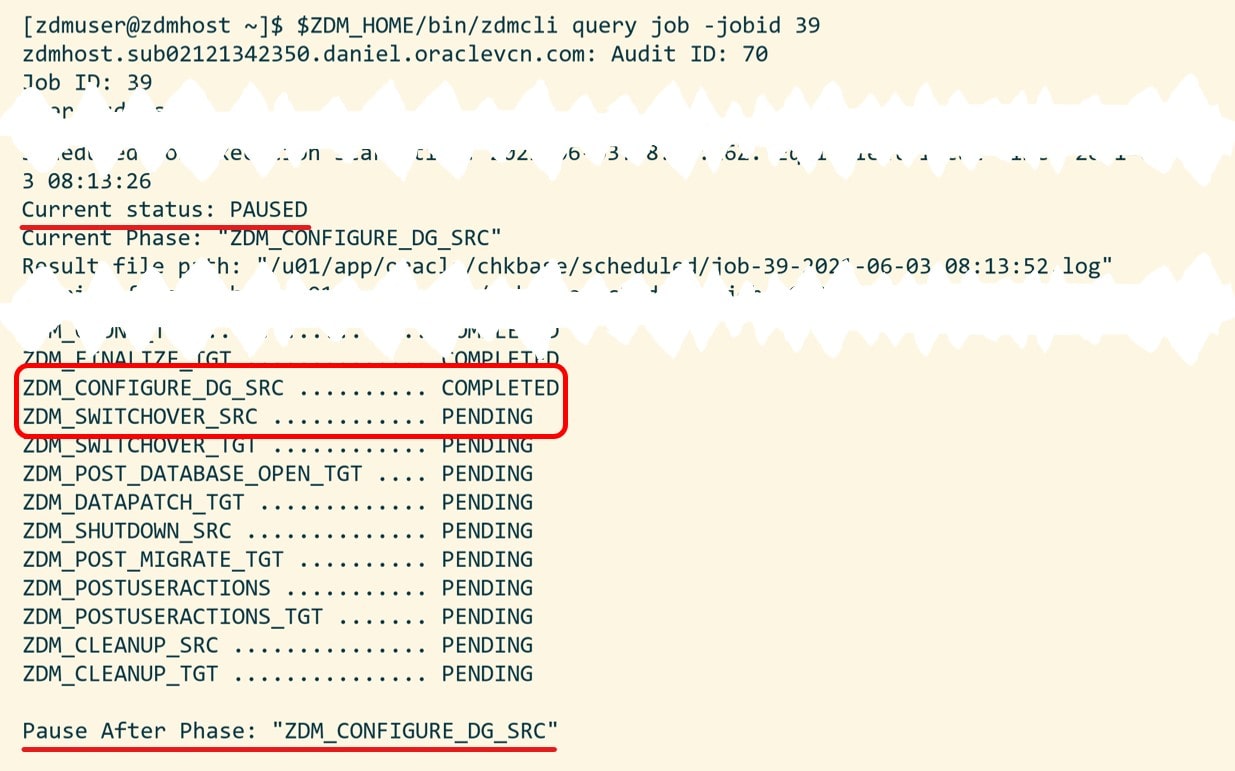
Now the standby database has been built in OCI. Redo gets transferred from my source database to the target database in OCI and is applied (see appendix D for monitoring queries). Also, this is a good time to test your new database.

Complete Migration

Now it is time to finalize the migration and switch over to the OCI target database. All I need to do, is to resume the paused ZDM job. I use the job ID that was created when I started the migration:

[zdmuser@zdmhost]$ $ZDM_HOME/bin/zdmcli resume job -jobid <job ID>

ZDM will now ensure that all redo is sent and applied before switching over to the OCI target database. Again, I use the zdmcli query job command to monitor the progress and I can tail the log file. After a short while the migration completes. ZDM migration completed

That’s it. I have now migrated into OCI!

I have a few post-migration tasks to carry out:

  • Configure automatic backup
  • Protect my new OCI database with a Data Guard in OCI
  • Take a peek at the alert log (just be sure)

Other Blog Posts in This Series

Appendix

A – RAC Databases

If your source or target database is a RAC database, then you only need access to one of the nodes. Select the node that you want to use and use the host name and SSH keys to that host. Also, ensure that the IP address you are using is not the floating one (VIP). In OCI that is referred to as the private IP.

B – Response File

Allow me to put some comments on the values:

Setting Comment
DATA_TRANSFER_MEDIUM When migrating to a DB System in OCI OSS is the only option. It is also the default value, so I could omit the parameter. The other options are applicable for Exadata Cloud at Customer and Exadata on-prem.
                                                                                                                                                                     HOST                                                                                                                                                                      Getting the right URL for the HOST parameter might be a little tricky, but check the documentation. In my demo I use the Frankfurt data center, and, thus, the region is set to eu-frankfurt-1. Visit the API documentation for a list of regions. Use OCI CLI and oci os ns get to find the tenancy object storage namespace. Alternatively, in the OCI Console (the web page) open the Profile menu and click Tenancy: <your tenancy name>. The namespace string is listed under Object Storage Settings. To read more about have a look at the OCI documentation. Thanks to Bartlomiej Sowa for putting in a comment with this information – much appreciated!
OPC_CONTAINER The OCI Object Storage bucket that will be used as a staging area for the backup of the source database. I recommend using a separate bucket for each migration. It makes it a lot easier to clean up afterwards.
PLATFORM_TYPE VMDB covers Virtual Machine and Bare Metal DB Services. It is also the default value, so I could omit the parameter.
SHUTDOWN_SRC I choose to shut down the source database to ensure no one uses it unintentionally after the migration.
SKIP_FALLBACK To make my demo simple I choose not to configure fallback. Remember falling back to the source database requires a license for Advanced Security Option or setting the paramete TABLESPACE_ENCRYPTION correctly.
TGT_DB_UNIQUE_NAME The DB_UNIQUE_NAME of the target placeholder database. It must be different than that of the source database.

C – Backup Strategy

During a migration with ZDM, you should keep your regular backup strategy. Keep doing the same backups as you did before. But avoid having ZDM backups and regular backups run at the same time. Also, if you are dealing with a RAC database be sure to put the snapshot control file on shared storage. Otherwise, you might get ORA-00245 errors during backups.

D – Monitoring

Use these queries to monitor the redo apply. On source/primary database:

SELECT 
   host_name, instance_name, db_unique_name, status, database_role, open_mode 
FROM 
   v$database, v$instance;
SELECT thread#, max(sequence#) FROM v$archived_log GROUP BY thread#;

Target/standby database:

SELECT 
   host_name, instance_name, db_unique_name, status, database_role, open_mode 
FROM 
   v$database, v$instance;
SELECT thread#, max(sequence#) FROM v$archived_log WHERE applied='YES' GROUP BY thread#;
--MRP process should be 'APPLYING_LOG'
SELECT process, status, sequence# FROM v$managed_standby;
SELECT * FROM v$archive_gap;

E – Troubleshooting

PRCZ-4001

If you run into this error:

PRCZ-4001 : failed to execute command "/bin/uname" using the privileged execution plugin "zdmauth" on nodes "doverbyh-zdm-tgt" within 120 seconds
PRCZ-2006 : Unable to establish SSH connection to node "doverbyh-zdm-tgt" to execute command "/bin/uname"
No more authentication methods available

Check your key files. They must be in RSA/PEM format (the private key must start with -----BEGIN RSA PRIVATE KEY-----).

ZDM_OBC_INSTALL_CREDENTIALS_INVALID

If you run into this error:

srchost: 07:08:00.000: Validating object store credentials..
srchost: <ERR_FILE><Facility>PRGO</Facility><ID>ZDM_OBC_INSTALL_CREDENTIALS_INVALID</ID></ERR_FILE>

Check your credentials to OCI. Remember when prompted for the password of your OCI account it is an auth token, not your password (even though the prompt text is misleading).

ZDM_GET_SRC_INFO

If the phase ends in PRECHECK_FAILED and there is no real clue about the error, ensure that the source database host is added to the known_hosts file on the ZDM service host. Also, you can verify connectivity by trying to log on via SSH:

[zdmuser@zdm]$ ssh -i <specified-key-file> opc@<name-of-source-host>

ZDM_GET_TGT_INFO

If the phase ends in PRECHECK_FAILED and there is no real clue about the error, ensure that the target database host is added to the known_hosts file on the ZDM service host.

[zdmuser@zdm]$ ssh -i <specified-key-file> opc@<name-of-target-host>

ZDM_SWITCHOVER_SRC

If the migration is stuck at the phase ZDM_SWITCHOVER_SRC and you see the following in the ZDM log file:

zdmhost213: 2022-05-10T18:01:22.565Z : Executing phase ZDM_SWITCHOVER_SRC
zdmhost213: 2022-05-10T18:01:22.566Z : Switching database SALES2_fra3cx on the source node srchost to standby role ...
zdmhost213: 2022-05-10T18:01:22.566Z : checking if source database is ready for switching role...
srchost: 2022-05-10T18:01:35.340Z : Validating database SALES2_fra3cx role is PRIMARY...
srchost: 2022-05-10T18:01:35.742Z : Validating database SALES2_fra3cx is in open mode...
srchost: 2022-05-10T18:01:36.144Z : Waiting for SALES2_fra3cx to catch up, this could take a few minutes...

Then proceed to primary and standby database and investigate whether there are any log shipping or log apply problems. The root cause can be many different things, for instance conflicts when negotiating network security options.

PRGZ-3420 / ZDM_MANIFEST_TO_CLOUD

Check the ZDM log file stored on the ZDM service host in $ZDM_BASE/chkbase/scheduled. If you find this error:

zdmhost213: 2022-05-10T18:20:34.330Z : Executing phase ZDM_MANIFEST_TO_CLOUD
zdmhost213: 2022-05-10T18:20:34.331Z : registering database "SALES2_OCI" to Oracle Cloud
tgthost: 2022-05-10T18:20:50.895Z : Updating DBAAS wallet keys ...
####################################################################
PRGZ-3420 : failed to modify keystore entry "oracle.security.client.password1" in wallet "/var/opt/oracle/dbaas_acfs/sales2/db_wallet".

The proceed to the target host and find the log file from that phase. It is located in $ORACLE_BASE/zdm/zdm_<target_db_unique_name>_<zdm_job_id>/zdm/log. Do a grep:

cd /u02/app/oracle/zdm/zdm_SALES2_OCI_12/zdm/log
grep "cloud registry" zdm_manifest_to_cloud_*.log

If you find the following lines in the log file:

grep "Error: Missing cloud registry" zdm_manifest_to_cloud_*.log
zdm_manifest_to_cloud_337115.log:Error: Missing cloud registry file SALES2.ini

You have most likely used the wrong case of DB_NAME on the target database. You choose that in the OCI console in the field Database name. In this case, DB_NAME in source database is SALES2, but I had incorrectly used sales2 (lowercase) for the target database. Normally, DB_NAME is case insensitive, and it is to the database itself. But the OCI cloud tooling is not case insensitive. Looking in /var/opt/oracle/creg on the target database, I can find a file called sales2.ini but ZDM is looking for SALES2.ini. How do you solve this? If this is a test database, then scratch everything and start all over. But bear in mind that the switchover has already taken place, and the OCI database is now the primary database. For a production database this is tricky. First, the database has been migrated to OCI. It works. All your data is fine on the target database. But the OCI cloud tooling does not work properly. You need to open a SR and get assistance from support.

PRGO-4086 : failed to query the "VALUE" details from the view "V$ARCHIVE_GAP" for database "target_db_name"

If the switchover fails during this query:

select count(*) from v$archive_gap

And your target database is 11.2.0.4 or 12.1.0.2, you have hit bug 18411339 (Low performance or ORA-1220 for query on V$ARCHIVE_GAP on 11.2.0.4 or later release). Apply the patch on the target database and retry the ZDM migration. You can also open the target database before you start the switchover process (requires Active Data Guard because redo apply must be on). The above query fails only when the standby database (the target database) is mounted. It works fine on an open database.