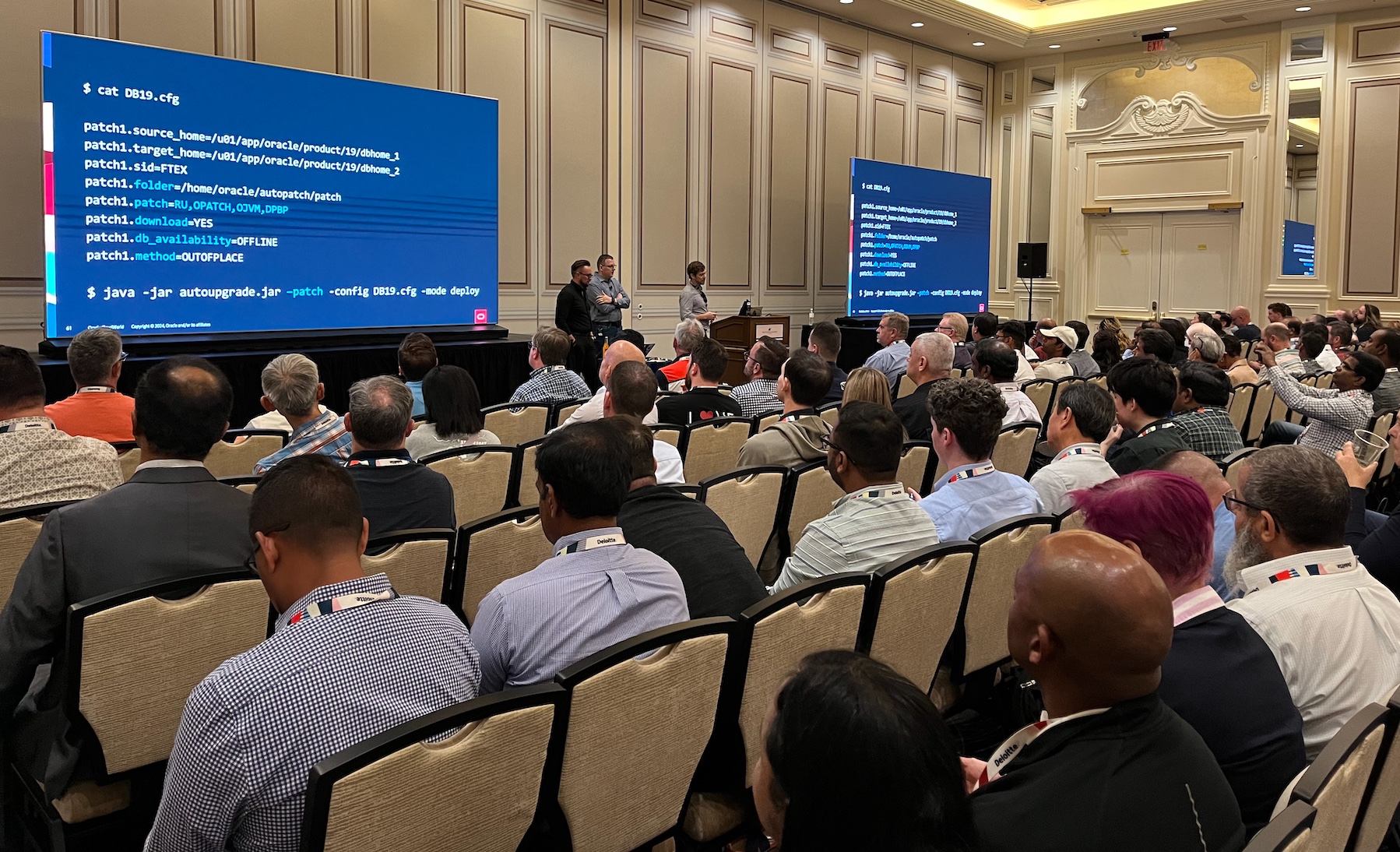
You don’t even need to specify patch numbers; just tell us you want the latest patches. Patching has never been easier.
CloudWorld Hub
The CloudWorld hub is open, and there’s plenty to do:
Check out the F1 racer and try one of the race simulators. It’s right behind the database demo booths.
Relax with pinball, table football, and Guitar Hero. The pinball machine does bring back a lot of childhood memories. It’s right after the entrance on the right.
Get an AI generated avatar for your profile pictures. The machine takes a picture and comes back with an AI generated picture of you on the Premiere League football pitch, F1 racing court, cricket game or sailboat.
Get a bunch of stickers from all around and generate your own sticker at the database demo booth.
Pet the dogs. Relax yourself by playing with some of the dogs. Yup, that’s right. There are dogs to give you a good amount of paw-love. Plus, the PS Websolutions booth has Kirby the Chihuahua, who’s also looking for someone to pet him.
My team and I spent the day in a full-day workshop about upgrade to Oracle Database 23ai and migration to the multitenant architecture.
Pro Tips
Today was a kind of warm-up for tomorrow. Get the most out of the conference with these pro tips:
You get the best coffee by far at Dandelion Chocolate near the front desk. Second best is at Zeppola Cafe at Sct. Marks Square.
Get the Oracle Events app. It’s your trusted companion.
Pick up your badge in good time. The lines for badge pick-up on Tuesday morning will be long.
Bring a light sweater or jacket. The A/C is brutal in some places.
Show up for the sessions in good time. Although you registered for a session, they let people in on a first-come-first-served basis. Don’t miss a seat by showing up late.
Rate the sessions and leave feedback. We want to improve and ensure you get the most out of it.
If you signed up for a hands-on lab or tutorial, be sure to bring your laptop. We do have loaners, but not everyone likes a US keyboard.
Come to the CloudWorld hub and visit the demo booths. Product Managers from all areas are present and they are eager to answers all your questions. Engage with us, please.
While at the CloudWorld hub, stop by the ACE lounge and ask one of the ACEs why you should become the next Oracle ACE. You’ll not regret joining the community. And ask when the chocolate tasting takes place.
Stop by the merchandise shop and arm yourself with cool accessories.
Are you considering coming to Oracle DatabaseWorld at CloudWorld, or have you already secured your ticket? Here’s a great opportunity for you.
Imagine being in a room with the very people who design and develop the Oracle Database you use every day. The pre-event training at Oracle CloudWorld offers this unique opportunity. My team will be there, and guide you through the upgrade and migration to Oracle Database 23ai.
This is more than just a regular session. It’s an opportunity to dive deep into upgrade and migration to Oracle Database 23ai, understanding the why and the how directly from the source. It is 8 hours of intense training.
By attending our pre-event training, you’ll have the rare chance to learn directly from Mike Dietrich, Rodrigo Jorge, Alex Zaballa, and me. This isn’t just about listening to a keynote – this is hands-on, immersive training where you can ask questions, solve real-world problems, and gain practical skills that you can apply immediately.
This is the agenda that we’ve prepared for you.
After this training, you have the skills needed to upgrade to Oracle Database 23ai and migrate to the multitenant architecture.
In late June, my team hosted our 20th webinar in our Virtual Classroom series.
You can now get a curated version of the Q&A. It contains many good questions and answers that give you deeper insight into Oracle Multitenant architecture.
The Best Questions
Consider these questions and answers a little appetizer. You find many more in the Q&A document.
Do I need to convert my database to a PDB before I upgrade to Oracle Database 23ai?No. You can do it as part of the upgrade to Oracle Database 23ai. It is easiest to use AutoUpgrade for the process
Does catcon.pl parallelism require Enterprise Edition like many other parallel options?No. You can use parallel threads in catcon.pl on a Standard Edition 2 database
Any good idea on how to avoid service name collision on a server when two CDBs tries to
create a PDB with the same name?We’ve seen several customers implement procedures that create unique names for each PDB. The name of the PDB should not include information about the server or CDB because you often move PDBs around, and then it is impractical to update the PDB name.
One customer we worked with created a small PL/SQL function backed by a simple table. When called, the
function returned a unique PDB name. The customer used ORDS to expose the function as a web service.
Do you recommend Oracle Fleet Patching and Provisioning (FPP) in a small, but complex,
environment?The bigger the environment, the more benefit you get from FPP. Especially if you are using Exadata Database Machine as well. AutoUpgrade is our preferred tool for smaller environments, but the complexity talks towards FPP. FPP comes with a license cost that you must take into consideration as well.
Did You Miss It
In case you missed it, you can find the recording on our YouTube channel and get the slides.
I Love Questions
One of the reasons I like doing webinars is that I get questions from the audience. I love that for several reasons:
Many questions about a specific topics is an indication that I didn’t explain a topic very well. I use this as feedback to improve for the next presentation.
I can use it to tell where our product has weakness that we can improve.
It tells me something about how customers use our product. I always get amazed about the creativity with which our customers use Oracle Database.
I find gaps in my own knowledge and I can learn new things.
I want to grow my skills in Oracle Database. Can you help me get started?
Here’s my suggestion.
Conferences and User Groups
You should engage in your local user group. Attending meetups and conferences is a good way of learning and boosts your network. If you need to find your local user group, try to contact one of the local Oracle ACEs.
Come to Oracle DatabaseWorld at CloudWorld. It takes place in Las Vegas in September. Three days of intense learning, plus a pre-conference training day.
If you’re based in Europe, you can attend one of the major user group events.
DOAG 2024 Conference + Exhibition hosted by the German user group, DOAG. Many sessions are in English, even if you don’t know German it is definitely worth a visit.
In the last days of May, I had the absolute pleasure of attending the MakeIT 2024 conference. Once again, the conference was held in the beautiful seaside city of Portorož, Slovenia.
The conference is a joint venture with the JCON conference, so you can catch one or two sessions on Java as well. I really value learning about related technologies as well. This year I listened in on caching options in Java and the use of JDBC driver.
You should come next year. There is also a good selection of English speakers, so even for foreigners, there is a reason to travel.
The Slides
Workshop – Patching Oracle Database
This is a full workshop on patching Oracle Database. It includes a hands-on lab, so you can try it on your own.
You should flip through the slides if you want a deep dive on patching.
Best Practices for Upgrade to Oracle Database 23ai
This session and the slides help you prepare for the next long-term support release of Oracle Database.
Patch Me If You Can
This session and the slides give a quick fly-over of the essentials of patching.
Oracle Data Pump – News, Internals, Tips and Tricks
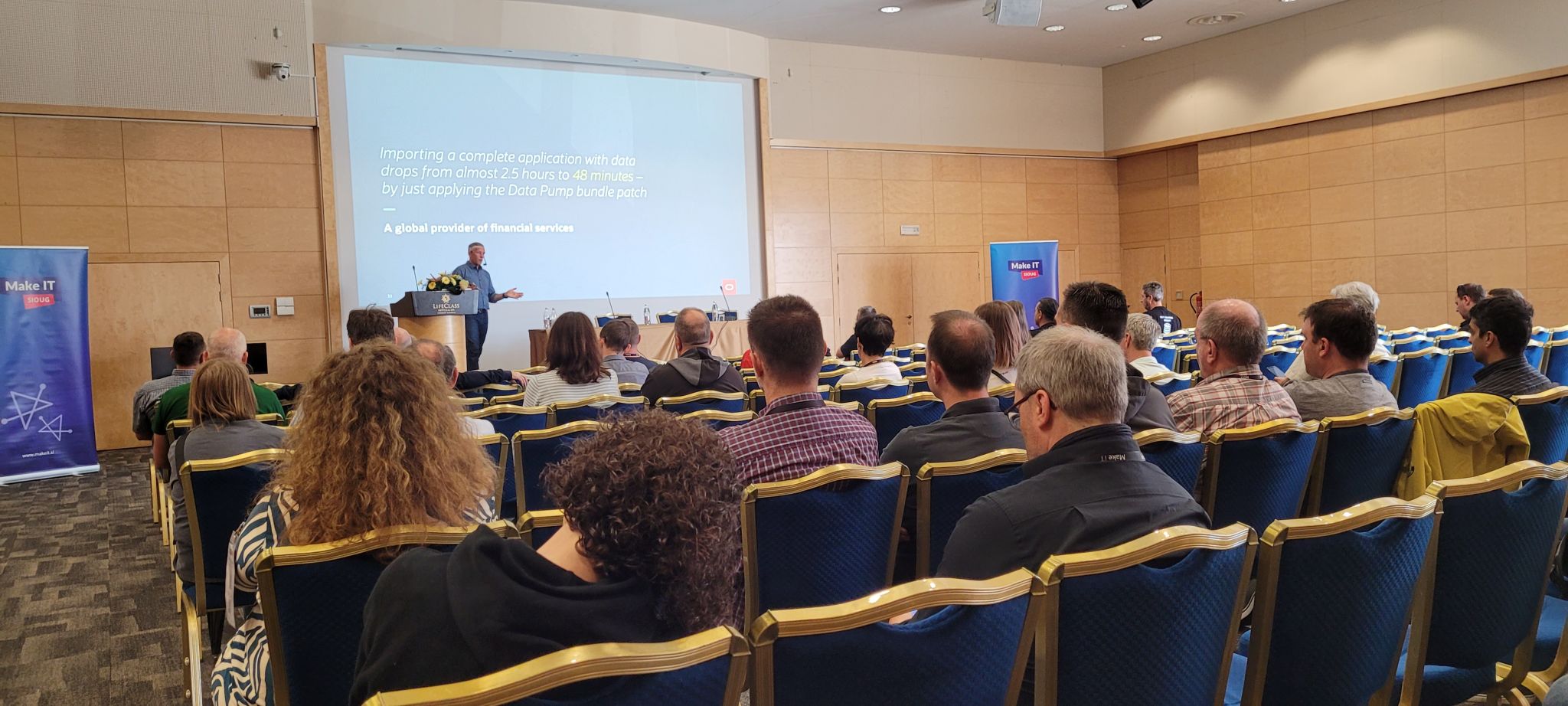
I had the pleasure of talking about Oracle Data Pump and presenting some new features. If you’re curious about a faster way of creating indexes and adding constraints, you can flip through the slides.
Thanks
Thanks to the organizer of MakeIT 2024 for pulling off yet another successful conference, to the sponsors for making it all possible, and to everyone who attended my sessions or the conference in general.
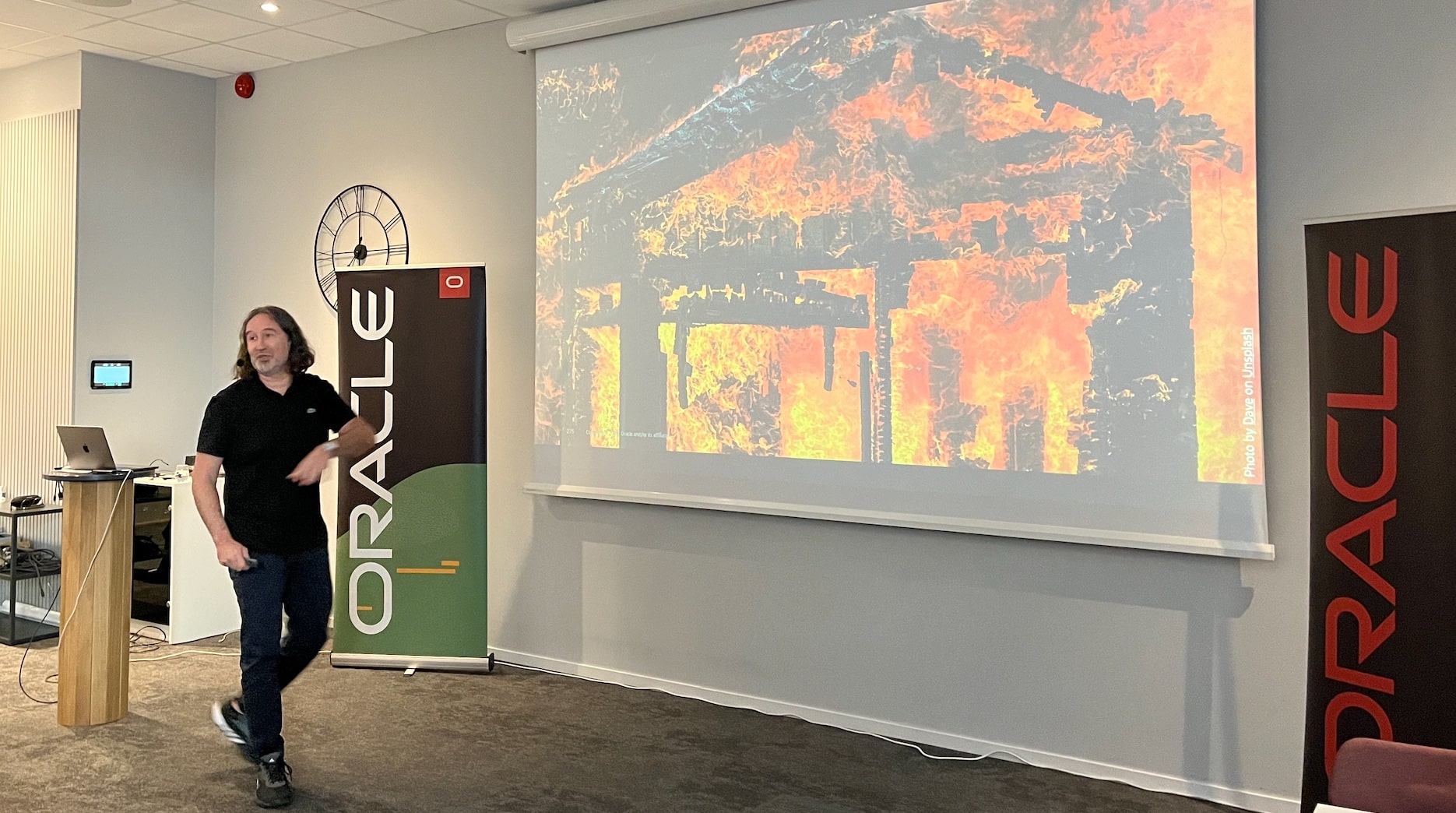
I’m on way back from the conference DOAG Datenbank 2024 in Düsseldorf. Before that I had workshops in Stockholm, Copenhagen and Frankfurt. I’d like to share some slides and impressions from the events.
Slides
Out-of-place Patching – The answers to the questions of the universe
You really should be using out-of-place patching. Why? It is much safer, takes work out of the maintenance window and so much more.
Real World Oracle Database Upgrade and Migration 19c & 23ai
A huge compilation of useful information about patching, upgrades, how to avoid changing execution plans and a lot of cool stuff from Oracle Database 23ai.
The German Oracle user group is called DOAG and they organize several great events throughout the year. I just came from the database-specific one, but in November their big conference is coming. It is really a great conference, so talk to your manager and see if you can come. Many sessions are in English, so you don’t have to speak German to come.
Reduce downtime to the time it takes to perform a switchover.
Test the patching procedure on the standby database.
I received an interesting question the other day:
I have the following two Data Guard configurations. I want to patch all the databases using standby-first patch apply. How do I do that when I have primary and standby databases running out of the same Oracle home on the same machine?
Requirements
In this case, the databases are on 19.17.0, and the customer wants to patch them to 19.23.0.
To use standby-first patch apply, you must meet a set of requirements, one being:
Data Guard Standby-First Patch Apply is supported between database patch releases that are a maximum of one year (1 year) apart based on the patch release date.
Here are the release dates of the following Release Updates:
19.17.0: October 2022
19.23.0: April 2024
So, in this case, the customer can’t use standby-first patch apply directly. There is a year and a half in between. They need to patch cycles in this case:
Patch to 19.21.0 (release October 2023)
Patch to 19.23.0 (release April 2024)
In the future, they should apply patches more often to avoid ending up in this situation again.
Patching Oracle Home
The customer has one Oracle home on each server from where both databases run. On any server, there is a primary and a standby database (from two different Data Guard configs).
The customer uses in-place patching. If they patch the entire Oracle home, it means one of the primary databases is now on a higher Oracle home than its standby database, which is not allowed.
The standby database is the only one which may run on a higher patch level.
Using the above configuration with primary and standby databases running out of the same Oracle home, you can’t use in-place patching and standby-first patch apply.
The customer must switch to out-of-place patching to achieve this. Then you can patch standby databases first, then the primaries.
To give you the best possible starting point for the multitenant migration, our team has prepared two webinars about the multitenant architecture. Actually, we planned on just one. Still, we have so many things to share that we decided to make two webinars. When product managers get a chance to talk, they talk a lot!
Move to Oracle Database 23ai – Everything you need to know about Oracle Multitenant
You can sign up here. My team (Mike, Rodrigo, Roy and Alex) will be there and answer all your questions. I promise we won’t end the webinar until there are no more questions.
If you miss the webinar, you can watch a recording later on our YouTube channel. Be sure to subscribe so you don’t miss out.
Even if you already use Oracle Database on multitenant architecture, I guarantee there are still new things to learn.
I just finished my presentation at OUGN 2024 conference in Oslo, Norway. Once again, it was held at the Rebel, which is an awesome location. Two intense days full of learning experiences.
It’s my second time at the conference, it I must give it my strongest recommedation. If you’re in Northen Europe, it’s an easy flight to Oslo and you really get great value for it.
The Slides
Introduction to Multitenant Architecture
What is multitenant? How does it differ from the non-CDB architecture. How can I move from non-CDB to a pluggable database? I answered all those questions and much more.
You should flip through the slides if you want an overview of the multitenant architecture.
Move to Oracle Database 23ai
This session and the slides help you prepare for the next long-term support release of Oracle Database.
More Multitenant
If you need to know more about multitenant, be sure to join our two webinars coming up in May and June.
Thanks
Thanks to the board of OUGN and the organizers for pulling yet another successful conference. Thanks to the sponsors making it all possible and to everyone who attended my sessions or the conference in general.
Impressions
The Dolerean
Beautiful sunset during the approach to Copenhagen Airport.